All Activity
- Last week
-
 Ece Ruiz joined the community
 -
 Sandra Shellhammer joined the community
 - Earlier
-
 Hi Harry, welcome to the forums. I can understand how frustrating this can feel ,especially when you have invested in dog treats hoping they would help, only to discover that their incentive value is not enough. It almost feels like “It’s as if my dog knows what I want but is choosing not to listen.” However, this type of dog behavior is rarely driven by a desire to be defiant. The truth is far more factual and less emotionally driven. In a nutshell, your dog is simply responding to whatever is most salient and reinforcing in that particular, given moment. In this case, the odor has become the highest-priority stimulus competing for the dog’s attention and behavior. Because every scent has the potential to reveal fascinating information, asking your dog to abandon a scent trail isn’t much different than asking someone to put down an exciting mystery novel just before the final chapter. In this case it comes natural to think, if my dog clearly hears us calling her and we have rewarded her with treats, why does she keep on sniffing? Is this a case of selective hearing? The answer often lies in the strength of the recall cue under strong distractions. A recall cue is not truly under stimulus control until the dog reliably responds across a variety of environments and levels of distraction. Stimulus control means that a specific cue (e.g., “Come”) consistently elicits the desired behavior because the dog has learned that responding to that cue is highly reinforcing. In the context of a recall, stimulus control exists only when the dog reliably comes after a single cue across a variety of environments, including those with competing distractions such as enticing scents. Dogs who learn to come when called promptly when in the house but struggle when they’re in the yard and interested in smells simply have not generalized that response to environments filled with highly rewarding scents, wildlife, or other competing stimuli. In these cases, yes, sniffing may be more reinforcing than the food reward being offered by the pet parent. Basically, the environmental reinforcement outweighs the reinforcement history for the recall. Let's continue to think of sniffing from our dog's perspective. Every time your dog sniff, it’s like opening another surprise package. While some sniffs may contain nothing remarkable, every now and then there’s this irresistible jackpot, under the form of a rabbit trail, the scent of another dog, or yesterday’s dropped hamburger. This unpredictable payoff is what makes sniffing incredibly difficult to interrupt. However, being aware of this variable reinforcement is powerful as it can help you formulate a strategic plan that will keep your dog on his toes when you call him too! So How to Get Your Dog’s Attention When His Nose Is Glued to the Ground? Every time you call your dog, you need to make sure that he rushes to you enthusiastically and the that reward given beats anything else. If coming when called consistently means the fun ends in exchange for a cookie or a treat he gets often every day, your recall cue can quickly lose its appeal. Here are some strategies to prevent that from happening. -Don’t Make the Fun End Imagine your spouse says: “Come here,” and every single time that means “It’s time to toss the trash” or “time to clean the garage.” With time, you’d become remarkably difficult to find! Now imagine that sometimes “Come here” means here’s your favorite dessert, let’s watch a favorite movie, or here’s a surprise gift, and occasionally, yes, we need to clean the garage. In this case, you’d respond much more enthusiastically because the cue has a long history of predicting good things. Now, if treats are given every time the dog is called when she’s sniffing, and the dog’s recall remains poor over time, this reminds us that reinforcement is something relative, not absolute. In other words, in that context, the scent has greater value in than the treat. -Increase Reliability Around Scent Distractions Calling a dog when he’s actively sniffing and getting a quick response isn’t something that is trained overnight. Here’s the thing: a reliable recall isn’t built by repeatedly testing the dog in challenging situations, but rather through systematic proofing. I like to think of scent distractions in terms of weights at the gym. You don’t start with the heaviest barbell during the first weeks! So here are some general tips to work on incrementally. If your dog fails repeatedly, don’t assume he’s being stubborn. It usually means the distraction level exceeds his current skill level. You may therefore need to go back to practicing under milder distractions and using higher value treats. -Begin indoors with virtually no distractions. -Practice in the backyard before your dog discovers an interesting scent. -Move to a quiet park. -Practice near mildly interesting odors. -Gradually work closer to stronger scent trails. -Finally, practice around the kinds of distractions your dog is most likely to encounter in real life. Use Premack to Your Advantage One of the most powerful reinforcers may already be right under your nose (pun intended). On a personal note, I love to use this principle, here's more about it: Premack Principle! According to the Premack Principle, a highly desirable behavior can reinforce a less desirable one. This is also known as Grandma’s Law, in terms of “eat your broccoli and then you can have ice cream. For a dog who loves to sniff, the opportunity to return to sniffing after coming when called can be an even better reward than food. Here’s an example on how to use it to your advantage: Call your dog. He comes immediately. Reward with a treat. Cheerfully say, “Go sniff!” as you point to the yard Let him return to investigating the scent. In this case, the message goes from “all the fun ends when my pet parent calls me” to “Coming when called doesn’t make the good stuff disappear, rather, it makes it happen.” How magical is that? After several reps of this, once the dog’s need for sniffing has satiated (let the dog sniff to his heart’s content until all the novelty wears off and he appears bored) it may be time to call your dog to come indoors. In this case, you will have to think “what does my dog love to do indoors?” If your dog loves to sniff, it may be worthy preparing a Snuffle mat loaded with several high-value treats and having that ready by the entrance. Or if your dog is hungry and he loves his food, present his food bowl. Think of Your Dog’s Recall as a Lifetime Investment Reliable recalls aren’t built in a weekend. Rather they’re developed through consistent practice and maintained throughout a dog’s lifetime. Even highly trained dogs with excellent recalls benefit from occasional “tune-ups” and surprise rewards to keep the behavior strong. And while a well-trained dog may come when called with impressive reliability, no recall is ever 100 percent guaranteed .No dog training is really guaranteed for that matter. I hope this helps, Please let me know if you have another questions! Keep us posted. Best, Adrienne
 -
 Jasmien DeGraeve joined the community
 -
 Michael Patterson joined the community
 -
 My 3 yo yellow lab puts her nose to the ground when w let her outside and she just wont pay attention when called- shes found a scent and doesnt want to come indoors. we treat her when she comes, but dosnt seem to be an incentive enough
 -
 JUAN VALADEZ joined the community
 -
 Kimberly Petty joined the community
 -
 Richard Wilkinson joined the community
 -
 BrandonHolt joined the community
 -
 Bonnie Hapner changed their profile photo
 -
Bonnie Hapner joined the community
-
 Wanda Tinney joined the community
 -
Sight and hearing challenged 8 mo old
Adrienne Farricelli replied to Karulynn Koelliker's topic in Dog Training & Behavior
Hi there, Welcome to the forums! Before beginning brain games, I would encourage you to think of your dog's nose as the primary way he gathers information about the world. Rather than adapting scent games to fit a visually or hearing-impaired dog, try to view scent-based activities as his natural learning modality. For dogs with partial vision and hearing loss, consistency becomes especially important. Try to conduct training sessions in familiar environments with minimal clutter and few unexpected obstacles. Predictability helps reduce cognitive load and allows the dog to focus on the task itself. Since you've noticed he responds better to lower-frequency sounds, you may find that deeper vocal tones, gentle tapping on the floor to create vibrations, or consistent auditory cues are more effective than higher-pitched sounds. For brain games, I would start with simple scent searches. Scatter a few treats in a small area and allow him to use his nose to locate them. As he gains confidence, you can progress to hiding food in boxes, snuffle mats, rolled towels, or scent trails leading to a reward. Success should come easily at first to build confidence. You may also find tactile cues helpful. Many sensory-impaired dogs learn to respond to gentle touch signals as long as you associate them with something good happening (like touch, followed by a treat) so as to not trigger startling. Most importantly, allow him to work at his own pace. Dogs with sensory impairments often spend more time gathering information from their environment. What may appear to be slow progress is frequently the dog processing information through a different sensory pathway. As humans, we often focus on deficits, but many sensory-impaired dogs become remarkably skilled problem-solvers because they learn to rely so heavily on their remaining senses. A dog whose nose is 'his eyes on the world' is often an excellent candidate for scent-based enrichment and cognitive games. One additional tip: avoid startling him. Approach from a consistent direction when possible, announce your presence through gentle floor vibrations or a familiar low voice, and pair interactions with positive outcomes. Confidence and predictability are often just as important as the games themselves. -
How do I modify the techniques for a sight challenged and hearing challenged dog? His hearing is better with lower sounds. He has a hard time recognizing the source of the sound. Sight is partial in one eye. His nose is his eyes on the world. Hay help or advice before we begin with brain games would be most appreciated n
-
How to teach a dog to be gentle
Adrienne Farricelli replied to Paula Breeze's topic in Dog Training & Behavior
Hi there, welcome to the forums Management in these cases comes first. Tommy should have protected zones where Gus cannot physically reach him, gated areas or rooms separated by baby gates. Blind dogs especially benefit from predictable, protected pathways through the home so they are not surprised by sudden physical contact. Second, teach Gus a default behavior around Tommy. Many households succeed with a “go to mat” or “settle” cue. When Gus notices Tommy moving or hears him nearby, you cue Gus to go to his mat and reinforce calm behavior there. Over time, Tommy’s presence becomes a signal for relaxation rather than play attempts. Third, proactively drain Gus’s social and physical energy before he interacts with Tommy. Structured walks, scent games, food puzzles, and short training sessions lower baseline arousal. A dog that has already spent mental and physical energy is far less likely to bounce toward the older dog. Fourth, interrupt play attempts early and calmly. The moment Gus begins orienting toward Tommy in a playful but intrusive way, stiffening, bouncing, pawing—redirect him before Tommy has to escalate. Quiet redirection paired with reinforcement for disengagement teaches Gus that leaving Tommy alone is the successful strategy. It is also worth noting that some bully-type dogs, tend to show strong “play persistence.” They keep trying because historically persistence has worked with other dogs. That trait is not malicious; it simply means the human has to set clearer boundaries about when play is and is not available. Your daughter’s dog being careful around Tommy is a useful observation. Some dogs naturally show what behaviorists call self handicapping, where the larger dog reduces intensity with a smaller or older partner. Gus may eventually learn some version of that, but relying on spontaneous restraint is risky given Tommy’s health. Finally, try to remove yelling from the interaction loop if possible. When you raise your voice, Gus likely experiences the sequence as: approach Tommy → exciting chaos → owner upset. Calm redirection paired with reinforcement tends to produce clearer learning and less emotional fallout. In many homes the system becomes fairly peaceful once the younger dog learns a simple rule: the old dog is not a play partner. He is simply part of the environment. Over time, younger dogs often shift from solicitation to quiet coexistence, which is exactly the retirement plan a 14-year-old dog deserves. I hope this helps, happy training! Best, Adrienne -
Introducing puppy to bigger dog in home
Adrienne Farricelli replied to Danica Liebold's topic in Dog Training & Behavior
Hi there, Welcome to the forums! A nine-month-old, 50-lb adolescent dog and a ten-week-old, 6-lb puppy are operating on very different physical and neurological settings. The older dog is in the canine equivalent of the teenage phase, that is high arousal, strong play drive, and still learning impulse control, whereas, the younger puppy is developmentally fragile and lacks the coordination to protect herself. The concern you’re raising is therefore legitimate; injuries between puppies in this kind of size mismatch are entirely possible, but usually occur accidentally rather than through aggression. The first principle is management, not training. The older puppy should not have free access to the smaller one during the first weeks. Use barriers such as baby gates, exercise pens, or crates so the dogs can see and smell each other without physical contact. This prevents the older dog from rehearsing overwhelming play while the small puppy is still settling in. Controlled introductions should be brief and structured. Keep the larger dog on leash initially and allow the puppies to interact for only a few seconds at a time before calling the older dog away and reinforcing calm behavior. The goal is to teach that disengaging from the puppy earns reinforcement. Many young dogs can play appropriately, but they need frequent interruptions because their arousal escalates quickly. Teach the older puppy a few specific impulse-control skills before the new puppy arrives. A reliable “go to mat,” “leave it,” and a recall away from play are extremely useful here. When the small puppy moves around the room, reinforce the older dog for choosing calm behaviors such as lying down, sitting, or observing quietly. This builds a habit of settling rather than charging toward movement. Supervise all play sessions closely. Healthy puppy play includes loose bodies, frequent pauses, role reversals, and self-handicapping from the larger dog (for example lying down or reducing intensity). If the larger dog begins to chase, body-slam, pin, or ignore the smaller puppy’s attempts to disengage, calmly separate them and allow both dogs to reset. Do not rely on the older small dog or the cats to regulate the adolescent dog’s behavior. While some adult animals will correct a youngster, it is not fair or safe to expect them to manage interactions with a vulnerable puppy. Human supervision should be the primary control system. Finally, remember that fatigue and excitement both increase the risk of rough play. Short training sessions, sniffing activities, food puzzles, and walks for the older puppy will lower baseline arousal and make gentle interactions more likely. With careful management and reinforcement of calm behavior, most adolescent dogs learn surprisingly quickly that the tiny newcomer is not a wrestling partner but a fragile member of the social group. The important piece is preventing the older dog from practicing overly rough play during those early weeks while the small puppy is still physically delicate. I hope this helps! Happy training! -
Puppy walking into my legs
Adrienne Farricelli replied to Robyn Basman's topic in Dog Training & Behavior
Hi there, welcome to the forums! Six-month-old Miniature Schnauzer puppies are social followers. Add excitement and poor spatial awareness and you get a mobile trip hazard. Of course, this can be particularly concerning, especially when around an elderly lady. What's going on in this puppy's mind? Let's take a look at some possible mechanics before digging deeper into solutions. -Mobile Reinforcement Movement is one of the strongest triggers for puppies. A standing person is boring; a moving person is a stimulus. -Attention-Seeking Puppies enjoy any form of attention. In the case of a puppy following around and becoming a tripping hazard, it's inevitable looking at them, telling them to move or even bumping in them. These can be all perceived as forms of attention. -Lack of Training As you correctly mentioned, lack of previous training may play a role. The puppy simply does not yet know where to go when the person stands up. The solution may involve several approaches. -Teach a default stationing behavior Train the puppy to go to a mat or bed whenever the person stands up. Start by heavily reinforcing the puppy for relaxing on a designated mat. Then add a predictable cue: person stands → puppy runs to mat → reward appears. Over time the stand-up itself becomes the cue. This converts the trigger from “follow legs” to “go park yourself.” -Build spatial awareness around legs Practice slow walking drills where the puppy is rewarded for maintaining a small buffer zone around the person. Some trainers use a treat magnet at knee height to guide the dog into position beside the leg rather than between the feet. Think of it as teaching “walk with” rather than “walk under.” Another option is keeping a treat at eye level so the pup can focus on making eye contact in what's known as attention heeling. Bother forms of heeling can be found here: https://www.braintraining4dogs.com/members/brain-training/obedience-101/heeling-attention-heeling/ Another option is tossing kibble or treats at a distance so that the puppy steers clear from her. A sit prior to tossing a treat can add some structure to the game. Baby gates can create safe walking lanes for the elderly owner while training is in progress. -Increase structured enrichment Six-month-old mini schnauzers often shadow people because they are under-stimulated. Short training games, sniffing work, scatter feeding, and food puzzles reduce the “follow the human entertainment channel” effect. I hope this helps, happy training! -
I have a 50 pound 9 m old puppy and will be getting a 6 pound 10 week old puppy in couple of weeks and am concerned about larger dog playing to rough or sitting, laying on her. How do I train larger pup to be easy with her. I have another older small dog that keeps him in line and 2 cats that let him rough house with them and they keep initiating the play but don’t want new smallest puppy to get run over.
-

How to teach a dog to be gentle
Paula Breeze replied to Paula Breeze's topic in Dog Training & Behavior
Thanks for your reply. My place is so small, it would be difficult to install a pet barrier but I’ll give it some thought. Little Tommy spends most of his time on a futon chair that Gus is not allowed on without permission so T does have a refuge. The advantage of such a small place is that the dogs are almost always within sight and voice command, so Gus can be called to Come and Stay when Tommy feels threatened. Thanks again. Isn’t it wonderful to be part of a community that cares so much about dogs? -

How to teach a dog to be gentle
Robyn Basman replied to Paula Breeze's topic in Dog Training & Behavior
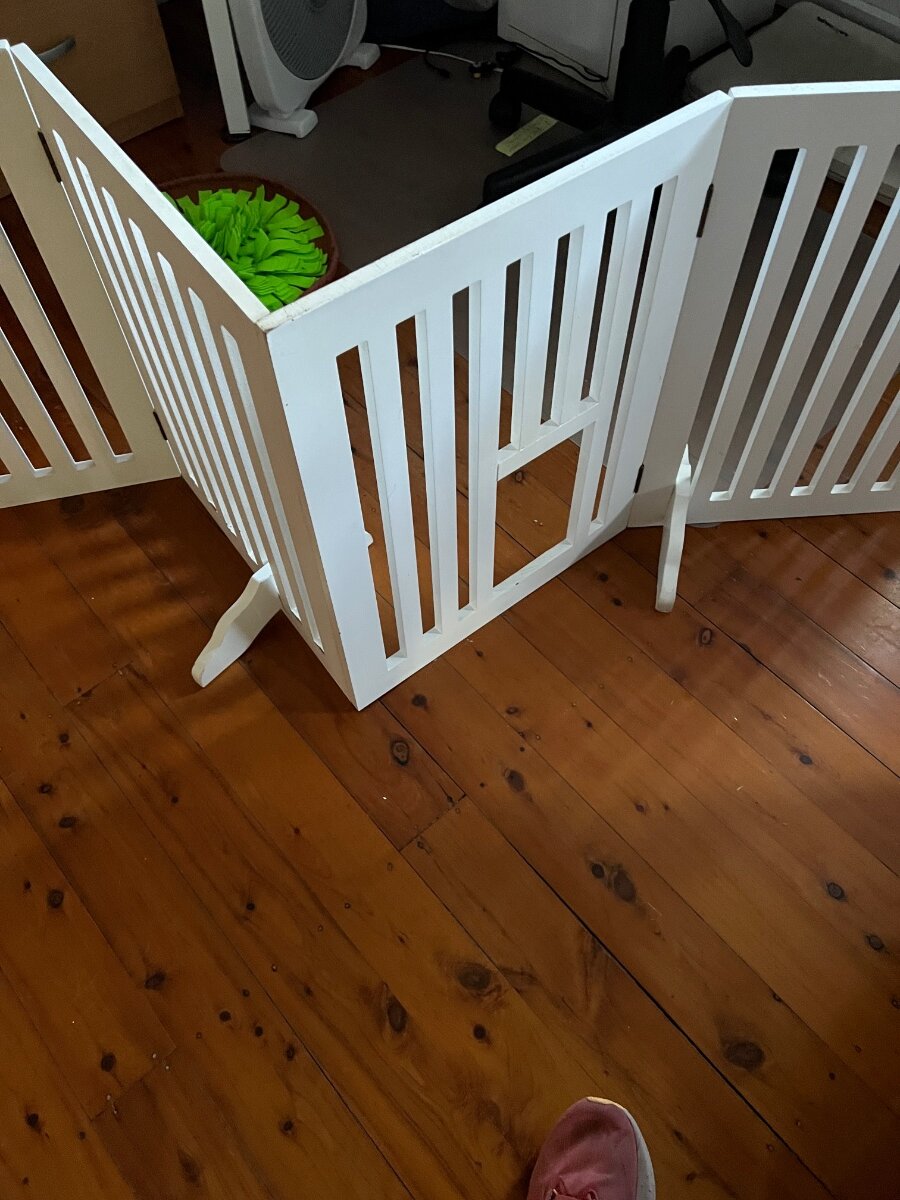
My husband modified that pet barrier for me -
How to teach a dog to be gentle
Robyn Basman replied to Paula Breeze's topic in Dog Training & Behavior
Initially when they interacted, I stood behind the larger dog, she had a harness with. a handle and sort of straddled her gently and gently intervened if she got too rough with encouraging her to “be gentle” . Over the years she has learned to handicap her play and to just leave the older dogs alone. Having a knowledge of canine body language is essential so you can pick up on your older dog Tommy’s early stress signals so you can give him the space he needs. Hope they answer the questions soon for you. I used to foster care and I do look after dogs and I teach a dog beginner class but I am not a behavioral trainer. I am here to learn what I can too. Hope this helps somewhat
-
How to teach a dog to be gentle
Robyn Basman replied to Paula Breeze's topic in Dog Training & Behavior
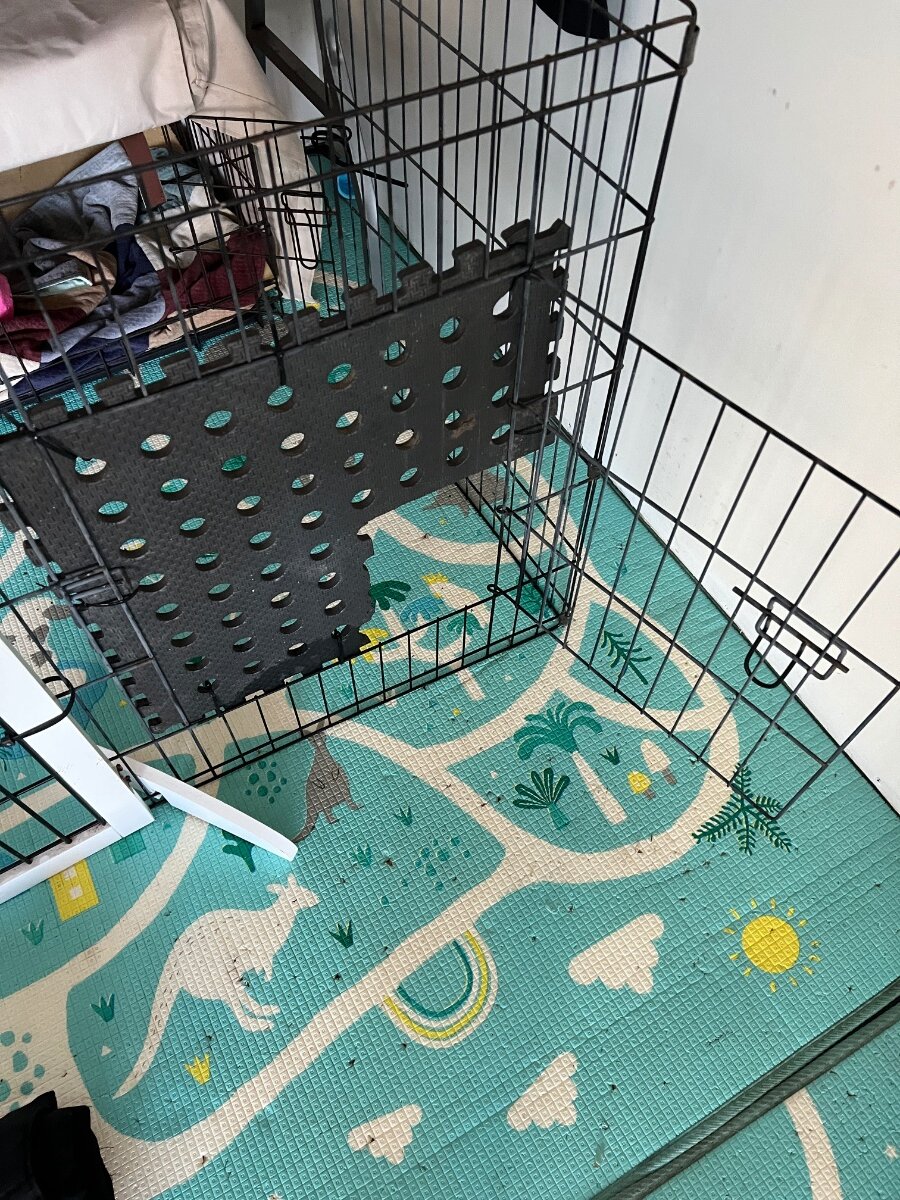
I noticed no one has answered your plea for help. I have a large Border collie cross rescue and a Maltese terrier and one thing I found helpful was to make a couple of small dog areas for my Maltese terrier so he can retreat to a safe area whenever he wants to. So an opening in a barrier that he can fit through but the larger dog cannot. I’ll try to add a photo -
Just some training ideas required for a six month old mini snauzer that has no previous training is walking into an elderly lady’s legs as she walks around the house. I’ve started with a relaxation protocol to teach the dog to self settle because the moment she gets up the puppy gets up to and walks into her legs also in between her feet etc. almost tripping her up as she’s walking. A trainer suggested shuffle walking and marking and rewarding when the dog is not doing it so essentially blocking the puppy but eventually gradually opening up to a normal gait. Any ideas appreciated. I’ll try to video it tomorrow
-
Tommy, a 20lb Jack Russell mix, has been with me for 14 years. We were a therapy team until I retired us and he was surely looking forward to a peaceful old age despite a heart condition, diabetes, blindness, and arthritis. Then Gus became part of our household 10 months ago. Gus is a 2yr old Bully. We’ve got to do something about the breed name; it’s so, so wrong. Gus is a 60lb teddy bear. He’s sweet-natured, extremely intelligent, and eager to please. He’s also big and strong and bouncy. He wants desperately to play with poor Tommy but he’s too rough. Tommy, never shy about speaking out, gets angry, barking and snapping, and I worry about his weak heart. Then I’m upset and yell at Gus. He’s crushed and I feel even worse. Nobody wins. How do I teach Gus to be gentle? Thanks in advance for your help, Paula B P.S. When I chose to adopt Gus, I realized that life would become difficult for Tommy. But Gus’s options were dismal. Libby, my daughter’s 3yr old Staffie/Pit mix, stays here 2-3 afternoons a week and, while having some behavioral problems of her own, is inordinately careful of little Tommy. PB
-
Anxious Maltipoo puppy
Adrienne Farricelli replied to Snehanand Sinha's topic in Dog Training & Behavior
Hello, Thank you for describing the situation in such detail. What you’re seeing is concerning, especially given your puppy’s young age,so it’s good that you’re seeking guidance now. A 6.5-month-old puppy showing escalating anxiety, generalized resource guarding, stiffness, hard staring, lunging, and attempted bites suggests a combination of fear-based aggression and impaired emotional regulation. The fact that the behavior intensifies consistently in the evening and overnight is also clinically relevant. A few important points and recommendations: Safety and management come first Until this is properly evaluated, avoid situations where people are approaching him around food, resting places, or valued items. Do not attempt to “test” or challenge him. Management tools (leash indoors, gates, predictable routines, controlled access to resources) are essential to prevent rehearsal of aggressive behavior. Do not rely on firmness or confrontation While he may back off when you are firm, this is not a sign that the behavior is resolved. More often, it indicates suppression driven by fear. Over time, this approach increases the risk of bites that occur without warning. Avoid verbal or physical intimidation. Resource guarding at this age is suspicious Guarding that is broad (food, bed, objects, space) and paired with anxiety and unprovoked lunging is outside typical puppy development warrants a veterinary behavioral evaluation, not just training advice. The time-of-day pattern matters Behavior that worsens between 8 p.m. and 7 a.m. can reflect fatigue, reduced coping ability, sleep disruption, or underlying anxiety disorders. In some cases, medical contributors (pain, gastrointestinal discomfort, neurologic issues) must also be ruled out. Immediate steps you can take now -Feed in a quiet, separate area with zero interaction during meals -Remove access to high-value items unless supervised -Do not disturb him when resting -Keep interactions predictable, low-arousal, and brief -Ensure adequate daytime enrichment and structured rest periods 6. Seek professional help I strongly recommend scheduling an appointment with a board-certified veterinary behaviorist (DACVB) or, at minimum, your primary veterinarian with referral to one. Early intervention at this stage can significantly improve long-term outcomes, but delaying treatment can allow patterns to consolidate. Best regards, Adrienne -
Immediate corrective action required
Adrienne Farricelli replied to Tribe XGen's topic in Dog Training & Behavior
Hi Russ, Thank you for the thoughtful message and welcome to the forums! I’m glad to hear you’re finding the material useful and have already beginning to apply it. I appreciate you taking the time to clarify this point before promoting the system more broadly. You’re absolutely right to distinguish between attention-seeking behaviors and behaviors that pose a safety risk. The principle of not “entertaining” unwanted behavior is primarily aimed at avoiding reinforcement, but it does not mean allowing unsafe behavior to continue unchecked. For behaviors such as chasing the cat or jumping on a person, the priority is always safety and management. In those moments, calmly interrupting the behavior is appropriate. This can be done by using environmental management (leashes, barriers, tethers), blocking access, or briefly removing the dog from the situation, ideally in a neutral, low-emotion manner. The goal is to stop the behavior without adding arousal, frustration, or reinforcement. Once the behavior is interrupted, redirecting the dog to a clearly taught, incompatible alternative behavior (for example, orienting to the handler, going to a mat, or engaging in a different activity) is consistent with the system. Over time, proactive management and reinforcement of appropriate behaviors reduces the likelihood that unsafe behaviors will occur in the first place. So in short: unsafe behaviors should be calmly and efficiently interrupted for safety, while minimizing emotional energy and avoiding reinforcement. The longer-term focus remains on prevention, skill-building, and reinforcement of desirable alternatives. You’re thinking about this exactly the right way, and I’m glad you reached out for clarification. Please don’t hesitate to ask if additional questions come up as you continue working through the material. Happy training! Best regards, Adrienne -
Hi there and welcome to the forums. My apologies if my reply comes late. What you are describing is very interesting and thank you for taking the time to provide such a thoughtful description of Leia. this is actually a very helpful history, and I can understand why this has been both puzzling and frustrating. I don't find Leia's behavior unusual in presentation. Most importantly: yes, this is very fixable, though it typically requires a shift in how the behavior is understood rather than simply adding more training cues. From a behavioral standpoint, this does not look like in my opinion as a dog "needing more stimulation” in the traditional sense. Instead, I believe this pattern is most consistent with learned compulsive arousal tied to social context and predictability. The rubber ball has likely become Leia’s primary coping strategy when arousal increases, particularly when both attachment figures are present or when a transition occurs (someone entering the home). The fact that she sleeps when one person leaves, tells us this is not excess energy, but rather socially driven over-arousal as this behavior is context-specific ( in occurs when both people are present,/visitors arriving). In cases like this, the ball is primarily not a toy, but a self-soothing object that loses its power once the stimulating stimuli/events are gone. The good news is that this does type of behavior can be fixed by implementing a variety of behavior change strategies such as: Reducing rehearsal of the behavior (management is essential at first). Lowering baseline arousal/impulse control games. https://www.braintraining4dogs.com/members/archive/10-impulse-control-games-for-dogs/ Teaching alternative behaviors around arrivals that are incompatible with fetch (like laying on a mat) https://www.braintraining4dogs.com/members/video-archive/train-dog-go-to-mat/ Her background as a former stray, combined with her genetic makeup, makes this presentation very understandable. Dogs who have experienced instability often cling tightly to predictable rituals especially in emotionally charged moments. If you work through the impulse control and arousal-regulation exercises in the course, you should see meaningful improvement. This is a situation where less excitement and more predictability will help her far more than additional outlets. Please feel free to share follow-up details. I hope this helps, Happy training! Adrienne
-
Hello and welcome to the forums, You’re absolutely right that mental exercise can be just as fatiguing (and often more regulating) than physical exercise, especially for young, high-energy dogs. One of the main goals of this program is to expand an owner’s “toolbox” well beyond sit, down, and stay, and to show how cognitive work, problem-solving, impulse control, and choice-based activities can be incorporated into daily life. Regarding training philosophies, the approach here is grounded in learning theory and evidence-based, force-free methods. The emphasis is on teaching skills in a way that promotes emotional regulation, resilience, and clarity for the dog, rather than relying on pressure when distractions increase. In practice, many dog parents find that once behaviors are well taught and reinforced in varied contexts, food becomes just one of many possible reinforcers rather than a limitation. That said, the course is not about debating training labels. The goal is giving you practical, applicable strategies for mental stimulation, enrichment, and skill development that can be used with any breed or mix. You’ll find a wide range of activities designed to challenge dogs cognitively while also supporting calmness and self-control, not just energy expenditure. I’m glad you’re here, and I think you’ll find the material aligns well with your goal of raising a mentally satisfied, adaptable dog. Please don’t hesitate to reach out in the forums as you start applying the exercises to your puppy’s daily routine. Happy training! Adrienne
-
I have a Maltipoo male puppy 6.5 months old. He is increasingly getting more nervous and resource guards his food, bed, and at times anything and everything. When anxious he tends to be stiff, have a blank stare, lunges even when unprovoked, and at times gets around to bite too. Fortunately, he backs off when you are firm and stay in the same place. This behaviour is more pronounced between 8pm and 7am. During the day he is far less anxious. Please recommend steps to take
-
 Bryan Ramona changed their profile photo
 -
just wanted to say I’ve been going through the material and I really like the approach so far. I haven’t completed the full course yet, but I’ve been reviewing it and starting to apply some of the methods with my own dog, and I’m excited to begin promoting it. I did have one question about something I want to make sure I fully understand before pushing it more heavily. I understand the principle of not “entertaining” unwanted behavior — not reinforcing it with positive or negative attention. That makes total sense for attention-seeking behaviors. But when it comes to behaviors that could be unsafe or harmful, like my dog chasing the cat or jumping on someone, simply ignoring it doesn’t seem effective in the moment because the behavior continues. What’s the recommended approach in those situations? Is the goal to calmly interrupt and redirect to a correct behavior without adding emotional energy, or is there a specific method the course prefers for handling unsafe actions? I really want to make sure I’m using the system correctly as I’m applying it in real life. Thanks again — I’m genuinely enjoying the content and looking forward to working with it more. Best, Russ
-
My significant other sent me this link a long time ago. I finally sat down and read it and said, we need to do this for our rescue dog Leia. We can see that she's super smart, but she's developed one specific behavior that is very frustrating. She is completely obsessed with a rubber ball and plays with it from morning to night non stop... as long as BOTH of us are in the room. If one of us leaves, she lays down and goes to sleep. As soon as another person comes to the door or through the door, instead of greeting that person, she grabs the ball and runs to me to have me throw it in the living room again. And manically, she'll continue to do that over and over again until that other person leaves, or until I put the ball away, and then she grabs another toy to do the same thing. Is this unusual and, more importantly, is this fixable? Thank you. We've gone to several trainers and can't seem to figure this out. She is 51% shepherd, 22% pit bull, 17% staffer. Terrier, with little bits of mastiff and pug DNA also. She was found as an emaciated stray in Lancaster, PA and the rescue people got her back to health. We adopted her last October and she's now a healthy and active 55 pounds!
-
Hi, I recently purchased the course access. I needed an inventory of ideas on how to keep my new puppy mentally exercised, which I heard may be just as tiring to a dog as physical exercise. And so I went ahead and bought it. I also come from using Garret Wings DIYK9 courses and online videos for training information. He is what you call a balanced trainer, where he will be 90% positive reinforcement and 10% pressure on the dog for when there are no treats or maybe when there are distractions present that are stronger than the lure of treats. Whether or not you all approve of such methods, what I hope to gain from here is learning how to keep my new dog mentally stimulated, and not just sit, down and stay. Which are good but may not be enough for certain high energy breeds.
-
Two German Shepherd puppies (now what??)
Adrienne Farricelli replied to Danny Brown's topic in Dog Training & Behavior
Hi, welcome to the forums, As a dog trainer/behavior consultant, I cannot provide medical or nutritional advice. Ideally, this should be answered by a veterinarian or a board-certified veterinary nutritionist. It sounds like you are in the weaning process and this requires specific instructions based on a variety of factors such as age, weight, overall health etc. I hope that by now, you have found the answer and that your pups are thriving. -
Hello, and welcome to the forums. Dogs must have an odd relationship with the phone. If we try to think about phones from a dog’s perspective, it makes us wonder what they must think about us when they see us hold that rectangular device to our ear and start babbling away like it’s the most normal thing in the world. It’s sort of like living in a sitcom! If we think about it, phones make lots of different noises: rings, pings, bleeps-you name it. Dogs understand that we are very responsive to every noise the phone makes. It must feel like living with a human who’s obsessed with squeaky toys! On the other hand, with a dog’s fine sense of hearing, we must consider how rings and notification pings must feel to them. Perhaps they feel very unsettling, like nails on a chalkboard. Then, there’s the mystery of voices coming from the other end. Are people trapped in there and need help getting out? Is that Uncle Martin stuck in another world? Perhaps that explains why owners rush to the phone when it rings; they’re on a mission trying to rescue them! And let’s not forget how humans go bonkers when looking for a lost phone. The relief felt upon finding it must feel like digging out a buried treasure. But the real kicker? Dogs witness us engaging in animated conversations, laughs, giggles, cries, maybe even shouting. They pick up all our vibes and may want to bark or howl to join these emotionally charged conversations. So yeah, dogs have many good reasons to act suspicious about our phones. They are noisy, we spend way too much time on them, and they are not chew toys. No wonder why countless dogs are always trying to swipe that phone out of our hands! Why Do Dogs Act up During Phone Calls? The reasons why dogs may act up during phone calls may vary from one dog and another. Paying attention to the dog’s body language and the context that evokes the dog’s behaviors may help provide insights into the underlying causes. Of course, until the day dogs can talk, we may never really know with 100 percent accuracy what’s going on in their minds, but these are just a few possibilities. They Are Seeking a Connection At the top spot of possible causes for dogs barking during phone calls is the need for interaction/attention. Many dogs may experience negative feelings when they see us get on the phone or plop onto the couch and watch T.V. In particular, they may feel ignored. “Every time my human starts talking on that device, they forget I exist! Maybe if I do something to grab their attention, they’ll remember I’m here.” The connection-seeking behaviors dogs adopt may vary from one dog to another. Here are several potential connection-seeking behaviors: Pacing back and forth Whining Nudging Barking Pawing Licking Chewing Nipping Biting As mentioned, phone calls can be emotionally charged events. Your dog can sense your feelings, and the voices on the other side could trigger feelings of excitement, reactivity or arousal. Some dogs may recognize voices of people they know, and this may excite them as if they’re about to show up to the door-but then, they do not. Other dogs may get aroused or startled by the sudden movements we make to get to the phone. Some dogs may find the sound of the phone ringing or the vocal interactions as cues for play or social engagement, leading to heightened energy levels, and all that energy must go somewhere, triggering the onset of impulsive behaviors such as barking. They’re Bothered by Noises Some dogs struggle with noises emitted by phones, whether it’s the beeping or ringing or any sound notifications. If you are using a speakerphone, consider that the pitch of the person coming through the speakers may be uncomfortable to the dog. They’re Feeling Confused Since dogs don’t understand technology, when they hear us talking on the phone, they may not know that there is someone on the other side who is listening. Even if the dog hears the other person, it’s still confusing because that person is not present. All this talking can cause dogs to feel confused. They may think we are talking to them, but we aren’t really connecting with them. It’s normal for dogs to feel unsettled, and this can make it a stressful situation that prompts them to act out. They’re Feeling Frustrated Some dogs struggle during phone calls because they perceive them as a disruption to their routines. It may be possible that dogs also grow frustrated when they sense the phone as a barrier preventing them from receiving the attention and interaction they crave. Such dogs may vent their frustration by engaging in nuisance behaviors that may include barking. “Attention-seeking behaviors—also known as demand behaviors—start for a variety of reasons, including anxiety and uncertainty. But regardless of why they start, these unwanted behaviors are always maintained by learning.” explains Stephanie Borns-Weil board-certified veterinary behaviorist. There is one major problem with dogs who bark, whine or bite as a way to seek attention: their attention is often inadvertently reinforced. This reinforcement teaches the dog that their behavior works, and this causes the behavior to put roots and repeat. Here’s the thing: with attention-seeking dogs, every little sign of attention reinforces the behavior (making it more likely to repeat and strengthen over time). Just looking at your dog, talking to your dog or touching your dog qualifies as attention. Even attention of the negative type, such as scolding your dog or pushing him away, qualifies as attention nonetheless! It’s therefore super easy to fall into the trap of giving some form of attention to these dogs, especially when their needle-sharp teeth are used to prompt a reaction from us! Beware of Extinction Bursts An extinction burst is a phenomenon that is important to be aware of. When dogs try to get attention from us, they will often try with some mild behaviors. Let’s say they try by barking. Barking often gains some type of reaction from us, considering it’s an ear-piercing sound. We may look at our dog or tell them to shush. Soon, the dog is satisfied with the response and may start barking more and more during phone calls. At some point, the owner may decide to try to ignore the barking in hopes of it decreasing. Bark after bark, the dog may notice that the barking is no longer working, so he’ll often try barking louder. This intensification of the behavior in response to no longer getting attention is known as an “extinction burst.” On top of barking louder, the dog may also try something else in hopes of getting the owner’s attention again. Barking may work at getting the owner’s attention back, considering that it’s very difficult to ignore a dog’s barking. Soon, the barking behavior establishes and becomes the dog’s default behavior to engage in in the context of phone calls. Make Safety Top Priority! If your dog’s barking morphs into biting, play it safe and consult with a dog behavior professional. Of course, in the case of a dog biting, for safety, it’s best to have the dog wear a muzzle and have a behavior professional present to help during the assessment. What to Do to Stop a Dog From Barking During Phone Calls? Stopping a dog from barking during phone calls often requires a multi-modal approach. The behavior intervention plan may often involve a combination of management strategies and behavior modification. A dog behavior professional can guide you through the process and suggest the most appropriate, custom-tailored approach. Preventing Practicing of the Behavior Undesirable behaviors in dogs are practiced because they lead to some form of reinforcement (a desirable consequence). In the case of a dog barking when the owner is on the phone, the consequence that keeps the behavior alive is often attention, whether it’s positive or negative. To prevent the dog from being put into the position of repeatedly practicing the problem behavior and garnering attention, it’s important to take several preventive steps. Following are several possible preventive steps: Keeping the dog in a separate room during phone calls Going outside to make phone calls Placing the dog in a confined space during calls (crate, exercise pen) Keeping the dog behind a baby gate Behavior Modification While the above measures prevent the dog from practicing the problem behavior, it’s important to take steps to change the dog’s emotional response to phone calls. The type of behavior modification involved may vary based on the underlying emotions at play and the ultimate function of the behavior. Identify the Exact Triggers When a dog barks during a phone call, it can be helpful to identify the exact triggers that cause the dog to act out. If we are able to tease out an exact trigger, we know exactly what we may need to be worked on, and in some cases, the solution may be as simple as no longer exposing the dog to such a trigger if feasible. Does the phone ring evoke the barking? This can be teased out by testing whether the dog still acts out if the phone ring is muted. Does your walking back and forth during calls evoke the barking? This can be teased out by testing whether the dog doesn’t act out when talking while sitting. Does hearing other people on the other line evoke the barking? This can be teased out by no longer putting people on speaker phones, using headphones or pretending to talk to somebody and watching the dog’s response. Does your dog react only when you talk on the phone? This can be teased out by having another person talk on the phone and seeing if the dog acts out. Does your dog react when you suddenly leap to answer the phone? This can be teased out by getting up very calmly and nonchalantly to answer the phone. While the above are just some examples of triggers that may cause some dogs to act out, it is not uncommon for the behavior to have started in response to an initial trigger, but that trigger has generalized and caused other events to piggyback. For example, oftentimes, as in the case of attention-driven dogs, the dog may have started acting out in the middle of the phone call as the dog started feeling anxious about not being given attention, but then through repeated exposures, the behavior started happening earlier and earlier into the phone call, to the point where the mere phone ring could cue a barking episode. Turning Triggers into Positive Happenings A plan involving desensitization and counterconditioning may be a good place to start to change any negative emotions into more positive ones. Desensitization involves exposing the dog to their triggers presented at a lower level of intensity so as to reduce exaggerated responses that cause anxiety. In the context of a dog barking during phone calls, this may involve putting the ringer on a lower setting, not using the speaker phone, letting the phone ring at a distance (like from another room), and initially engaging in shorter phone calls. The phone calls should be as neutral as possible (not emotionally charged) to lower the chances of evoking arousal. Counterconditioning involves pairing the triggering stimulus or event with something positive. In the context of a dog barking during phone calls, this may involve feeding the dog treats when the phone rings and then while talking on the phone. Treats (or even the dog’s kibble if the dog really enjoys it) can be kept in the pocket or treat bag during the day so that all phone calls are turned into positive behavior-change opportunities. The Best of Both Worlds Desensitization and counterconditioning are often used in combination as they work in synergy, potentiating their effects. In a nutshell, the ultimate goal is presenting the trigger/event at lower levels of intensity while creating positive associations with it. Initially, it may help to create systematic set-ups so that we have better control over the situation. This could mean arranging with a friend to have him/her call you so that the phone can ring several times in a row (with the ringer on a lower setting) so that you can toss your treats immediately after every ring. It should look like this: Ring/toss treat, ring/toss treat, ring/toss treat repeated several times so as to start creating a positive association with the ring. You may find it helpful to toss the treat initially simultaneously to the first rings just so that your dog gets a feel of what’s happening before moving to tossing the treat right after the ring. The goal is to obtain what’s known as a positive conditioned emotional response where your dog starts actually looking forward to the ring because it means great things happen. Advancing to the Next Step (Raising Criteria) Raising criteria simply means moving to the next step once the dog shows signs of improving, leading to a dramatic reduction in reverting to the barking behavior. Ideally, criteria should be raised when there are no more barking episodes taking place. Once the dog does fine with hearing the ring and shows even signs of looking forward to hearing it, you can start with having the phone ring and you picking it up and tossing a treat. Ring, pick up phone/toss treat, ring, pick up phone/toss treat. Once your dog does well with that, very brief conversations can be started. It’s best to keep these as short and neutral as possible, and treats should be tossed frequently to prevent any barking. What If There Are Setbacks? If there are still setbacks where the dog reverts to wanting to bark, it’s important to carefully evaluate what may have gone wrong. Was the ringer tone too loud? If so, the volume will need to be adjusted. Is the dog less enthusiastic about the treats? If so, it may be time to invest in some higher-value treats. Did the dog show signs of wanting to bark before the treat was tossed? If so, faster treat tosses may be necessary so as to preempt the behavior, but it would also be important to carefully evaluate what may have gone wrong. If, for example, the dog did well hearing the ring but then struggled when the phone was picked up and brought to your ear, you may want to take a step back and go back to giving treats for hearing the phone ring and then finding an intermediate step to picking up the phone and bringing it to your ear, such as just touching the phone and then lifting it up a bit and then more. Training an Alternate Behavior It is common to get upset with dogs (and give them negative attention) when they engage in problematic behaviors, but what if we train them to engage in an alternate behavior to replace the unwanted one? Then we can at least give them some attention for engaging in a desirable behavior! A good cue to train in these cases is the “go to your mat” cue since being on the phone involves a certain level of duration. I would suggest having a plan in place by keeping some long-lasting treat on a tall, impossible-to-reach surface near your phone and having a mat nearby. This way, as soon as the phone rings, you can cue your dog to readily go to his mat and then reward him by giving him a long-lasting treat to keep him occupied. If you want a quicker solution, you can use an indoor pet fence and place the long-lasting treat already on the mat, and close the pet fence so that as soon as the phone rings, you can readily open the pet fence and cue your dog to go to his mat. The dog should readily go inside if he has noticed the treat on the mat. This may work if your dog isn’t prone to getting too frustrated by seeing the food in an enclosed area he cannot reach. Consult With a Professional When dogs bark or show concerning aggressive behavior, seeking the guidance of a professional for safety and the correct implementation of behavior modification is paramount. Working on behavior problems comes with risks, and every dog will need an individualized plan. Here are some professionals to reach out to: Board-certified Veterinary Behaviorists (DACVB) Here is where to find one near you: Find a Diplomate. Certified Applied Animal Behaviorist (CAAB) Certified Dog Trainers/Behavior Consultants Please ensure that the professionals used are committed to humane training and behavior modification methods. Frequently Asked Questions The process of changing dog behavior is always variable, and several adjustments/changes may need to take place. Every dog is an individual, so a cookie-cutter approach won’t cut it when it comes to behavior change processes. What If I Don’t Have Time to Cue My Dog to Go to His Mat? If you are expected to get several phone calls and you don’t have the time (or desire) to work on the behavior, it is best to use management and keep your dog away from the phone and confined with something to do (chew toys, Kong Wobbler, Licki-mat). Are There Other Ways to Keep the Dog Busy During Calls? If you know when you’re expecting a phone call, you can set up a treat dispensing toy that you can activate with the press of a button using a remote control. The phone ring will become a cue for the yummy treats to be dispensed. I personally like to use the Teach & Treat remote dispenser for keeping dogs out of trouble because it will dispense kibble or premium treats from up to 30 yards away. How Important Is Timing? It is always best that you work quickly to preempt the problem behavior; therefore, you want to intervene *before* your dog has the opportunity to bark. If you are late, it may be difficult to distract your dog once he has latched on; plus, you are allowing your dog to practice the behavior. If you know a phone call is coming, it’s best to have a plan in place and have a stuffed Kong or a Licki-mat ready so that you can provide it to your dog in his confinement area. What If the Phone Rings Unexpectedly? If the phone call rings unexpectedly, be ready to grab a handful of kibble or a few treats from your pocket to toss at a distance as you leave the room and close the door. Alternatively, you can even keep a flirt pole next to your phone on a desk to escort your dog into his exercise pen where you can then close him and provide him with something to happily chew on. I have used flirt poles with success in some critical cases, such as puppies not wanting to come back inside the home before being taught to come when called. Can I Just Toss Treats/Kibble When I Am on the Phone? Technically, you can, but if you decide to toss treats rather than cue your dog to go to his mat to chew on a long-lasting edible, be prepared to do so repeatedly throughout the call to keep your dog’s mind focused on chasing treats. You can’t get distracted here, as you will need to have your dog yo-yoing back and forth. If your dog loves this game, you can insert some obedience training into the mix by asking your dog to sit before you toss the treat/kibble. This way, you are also teaching some desirable behaviors on top of draining some energy, providing some mental stimulation and preempting the barking. Since you are on the phone, you can teach your dog to attend to hand gestures rather than verbal cues. The hand gesture for “sit” can be an upward hand movement with your palm open. Once your dog gets the hang of this, he may even default to sitting on his own before the treat is tossed. On top of sitting, you can also teach your dog other cues, such as to lie down, spin or hand target before you toss the treat. Watch for signs of your dog tiring. Dogs may revert to nipping when they are tired and don’t know how to communicate it. If you are expecting the phone call to get long, you can always cue your dog to go to his mat and enjoy a food puzzle. What If the Treats in My Pocket Are Finishing? It’s always best to have a backup plan and keep some extra treats/kibble that can be reached quickly on a nearby shelf or table so that you can toss your last few treats at a distance and go grab a new supply of treats. If you have one last treat and it is soft, you can always split that into several pieces and use those to buy some time as you go grab some extra “ammo.” What if I Am Worried About Calories or Don’t Want to Spoil My Dog’s Appetite? No worries, there are several options. If your dog loves his kibble, use it! Food bowls are only for our convenience. Just think how many opportunities for reinforcement you can hold by using your dog’s breakfast. If your dog responds better to treats, you can ask your vet for some low-calorie treats. What If My Dog Isn’t Interested in Eating? Some dogs may be anxious about the phone’s ring or the voices they hear. When dogs are in an anxious state, they may struggle to focus on anything else. In these cases, it may be important to consult with a vet and discuss whether some calming aids may be helpful. Will the Behavior Ever Stop? While no guarantees can ever be made on the outcome of training or behavior modification, the good news is that eventually, most dogs lose interest in you talking on the phone once they have found more interesting things to do. The chances of this happening are much higher if you provide your dog with enough exercise and mental stimulation during the day and ensure all your dog’s needs are met. The less dogs get to practice the problem behavior, the more they’ll gravitate towards the new, potentially more rewarding activities. Dogs with a long rehearsal history may require more time and effort. Does Ignoring the Dog Work? Oftentimes, when dogs engage in attention-seeking behaviors, the common advice is to ignore the dog in hopes of extinguishing the behavior; however, there are problems with this approach. While it may be easier to ignore a dog who is barking when we are on the phone, ignoring the dog for biting is more difficult because it hurts! A hand or leg movement may be interpreted as a form of interaction nonetheless. Furthermore, ignoring a dog’s behavior that has worked in the past in getting attention may trigger an extinction burst that may involve stronger biting. Unless we wear tall Wellington boots, it will be difficult to endure. Giving any type of attention during an extinction burst has a deleterious effect because it means we have reinforced the dog’s persistence, making the behavior more established and resistant to extinction. Should I Punish the Dog for Biting Me During Phone Calls? No, punishing the dog for biting can potentially make matters worse. The dog may perceive any intervention as a form of attention, or if corrected through a muzzle grab, alpha roll, or scruff shake, the dog may react defensively or become hand-shy. Punishment also doesn’t help in addressing the behavior. In many cases dogs acting up during phone calls are seeking a connection. Even something seemingly minor, such as saying to the dog “no” doesn’t address the root cause and provides no information about what you want your dog to do. There are many side effects associated with the use of punishment, which is why it is not recommended. The Importance of Addressing All of a Dog’s Needs While it’s important to manage the dog’s environment and take steps to encourage the dog to engage in an alternate behavior, it’s also paramount to address the dog’s underlying needs and emotions and take a “holistic approach.” Following are some extra tips. Provide Exercise/Mental Stimulation While in the past, most dogs were selectively bred to carry out certain tasks (herding, guarding, hunting, sniffing, etc.), nowadays, they are often left with nothing to do and depend on us to keep them entertained. It’s therefore important to meet a dog’s needs for exercise and mental stimulation. Make sure your dog receives daily exercises and enrichment so his body and brain are kept busy. If you must use the phone at set times during the day, it may help to ensure you have met your dog’s needs before getting on the phone. Walk your dog, ensure he has eliminated and play with your dog before putting him in his confined area with something to do (food puzzle, bully stick). Establish a Routine Dogs feel reassured when they are provided with a routine. Establish set times during the day for walks, training, play, exercise, feeding and elimination. Introduce verbal cues so that your dog knows what to expect and can anticipate safe and non-threatening interactions. *Make sure your dog has eliminated before getting on a long phone call; some dog may start barking as a way of communicating their need to be taken out! You may find it helpful to teach your dog the go potty on cue command. Lower Arousal Levels Many dogs struggle with strong emotions such as arousal and frustration. Impulse control training can be introduced so as to help a dog develop better coping skills in a positive way.. Lower the Anxiety Many dogs who display behavior problems are fearful and anxious dogs. These dogs need a routine and may benefit from anxiety-reducing products. There are many calming products on the market nowadays, from DAP sprays and diffusers to calming supplements and foods. Ask your vet for specific recommendations. If your dog is anxious on a daily basis, your vet may even prescribe medications to take the edge off. Ensure Your Dog Gets to Relax/Sleep Dogs who don’t receive enough sleep during the day tend to be more easily aroused and “on edge.” It’s important to teach dogs how good it feels to be calm and how to relax. It’s important to praise them for engaging in these desirable behaviors. You may need to take steps to create an environment that is conducive to relaxation and sleep. I hope this helps! Happy training! Best, Adrienne
-
Hi, the course is all online. You should have received your login information upon signing up. If that's not the case, please check your spam folder or contact support.