Leaderboard


Popular Content
Showing content with the highest reputation since 04/22/2020 in all areas
-
Hi I've been there not long ago If I had to re do it, my first concern would be impulse control, as it's a matter of security - fluent response to his name - response to smacking sound and look at me - drop it - leave it - sit - stay - come when called This seems to be very basic, but what you have the impression that going well at home will find a deaf ear when outside, or playing, or following critters... The other thing would be "life training" - crate and pen if you have - car !! This one should not be underestimated - handling and manipulation : touching collar, paws, putting harness and leash Because you just don't want every day basic doing becoming a fight every time Life saving tips : - forcing naps is life saving and life changing, as a cranky, bitey, not wanted to do anything puppy is likely tired but don't want to miss out - do not be greedy and cheap on the chews : chews are mental stimulation, and also calming. The right chew at the right time on a devil possessed puppy may transform him into an angel it seems a lot for just a start, but hope it'll help please post in the picture post when you have him 😉6 points
-
Hi Robert, Welcome to the forums! You have received excellent tips above. For ease of navigation, I will provide some of the links where you can find all the guides. The first days, it's mostly about getting the pup used to his new place and the crate and starting potty training. Puppy may whine at night so keeping him in the bedroom with the crate nearby can help him habituate and can help determine when and how often to be taken out (2-3 trips at night/early morning are not unusual initially.) Love the crate exercises: https://www.braintraining4dogs.com/members/video-archive/love-the-crate/ Main article on potty training: https://www.braintraining4dogs.com/members/archive/7-secret-potty-training-strategies/ Advanced potty training program: https://www.braintraining4dogs.com/members/advanced-potty-training/ Obedience guides are found in the link below. Since your dog is likely a young puppy you will need to factor in short attention spans, so make those training sessions brief and fun (you can start with just 2-3 minute sessions spread in 4-5 sessions throughout the day and see how it goes.) You want to end the sessions with your puppy still having fun so to inculcate eagerness to being trained. https://www.braintraining4dogs.com/members/brain-training/obedience-101/ Importance of socialization: https://www.braintraining4dogs.com/members/archive/socializing-your-puppy/ Smacking sound: https://www.braintraining4dogs.com/the-airplane-game/the-smacking-sound/ Handling exercises: https://www.braintraining4dogs.com/members/archive/exercises-to-teach-puppies-to-tolerate-touch/ Bite inhibition and bite inhibition games: https://www.braintraining4dogs.com/members/archive/biting-mouthing-nipping/ https://www.braintraining4dogs.com/members/archive/bite-inhibition-games/ https://www.braintraining4dogs.com/members/archive/train-dog-take-treats-gently/ Prevention of resource guarding: https://www.braintraining4dogs.com/members/archive/the-importance-of-preventing-resource-guarding-in-puppies/ Brain games are great to keep your pup busy and mentally stimulated: https://www.braintraining4dogs.com/members/brain-training/ As your puppy develops, exercises to prevent separation anxiety: https://www.braintraining4dogs.com/members/archive/exercises-to-prevent-separation-anxiety-in-puppies/ With a large breed dog as a mastiff, tackling jumping early is important: https://www.braintraining4dogs.com/members/behavior-training/jumping/ If you search the forums you will also find loads of extra tips for puppy nipping and lots of other puppy related info. Keep us posted when you get your pup! Happy training! Best, Adrienne3 points
-
Amazon has some relatively economically priced beginner sets. Without knowing the age of your GSD, though, I'll throw this caution out there: until 18 months their growth plates aren't fully able to handle the load and if they land wrong the soft tissue can get damaged. For smaller dogs it might be more like 12 months, but our bigger dogs are late bloomers. 🙂 The tunnels and weaving poles are still a-okay to use, I'd just avoid any jumping exercises until mature. There was a gal at the dog park once who had two GSDs and she would put them in a sit stay while she walked off into the wooded section (this dog park was Awesome). She'd hide two balls, one for each dog. Then she'd walk back and release them to find. It was fun to watch them proudly bounding back to her with their prizes. Meanwhile, there was my dog, head under water, fishing out rocks . . . lol. When he was a puppy I had a plastic pool for him and I'd put sinkable toys in there for him to pull out. I never did find a good use for his skill (I didn't know Adrienne, yet!), but he sure enjoyed it. This is the course I bought: https://www.amazon.com/gp/product/B017TBQ4Z2/ref=ppx_yo_dt_b_search_asin_title?ie=UTF8&psc=1 Most of them are around $60 for the poles, ring, and tunnel. If you have anyone crafty you could get them to build a ramp (I don't know what type of space you have available). In fact . . . I think I need my husband to do that with our spare lumber - glad you asked this question! 😆2 points
-
Dear members, We are pleased to announce our new potty training guide! Below is the link to enter Potty Training Supercharged https://www.braintraining4dogs.com/members/advanced-potty-training/2 points
-
Hi there, Welcome to the forums! I am not too much a fan of numbering sessions when it comes to length, frequency and number of reps because of so many factors (age, breed, history of training, health etc). When I worked for a big box store, we had modules that used a cookie-cutter approach to train dogs and the head trainer was very adamant in having the dogs do 10 sits in a row, 10 downs in a row etc. Were the dogs learning this way? Yes, their sits were getting quite mechanical as muscle memory sunk in. Did they look interested? Towards the end of the 10 reps I was seeing signs of tiring in some dogs. It didn't help that we had dogs of different ages and breeds all clumped together doing these exercises. So I would suggest putting more emphasis on whether the dog seems to be enjoying the interaction and not getting bored or frustrated. You can certainly try to do some reps as a trial and see how it goes. See what your dog thinks about it. Your dog may like to do some mix and matching of cues to stay interested and this can also help him/her discriminate between those cues. Always aim to end up the sessions on a positive note, before boredom or frustration sets in. Remember as well to add variety and distance, duration and distractions. All these cues once fluent at home, need to be taught as well in the yard, on walks, at the park and at pet stores. You can also integrate them into several impulse control exercises https://www.braintraining4dogs.com/members/archive/10-impulse-control-games-for-dogs/ Happy training!2 points
-
Try saving the article as a PDF. That seems to be working for me.2 points
-
Thank you! I really thought she’d throw a fit without her usual walk but we did training games outside for about 20 minutes then took a 5-10 minute walk to get her to poop and omg maybe it’s a coincidence but she was able to see a big dog from our steps and not completely freak!! She didn’t even bark she just stopped and stared which is huge! She did small barks at some passerby where our “backyard” is (I live in an apartment it’s basically grass and a bench with a fence to the street) but that’s the least foot traffic of all the areas near me. Then we’re playing some indoor fetch and tug (shes not ready to play outside yet, just doesn’t want to) to get out any extra energy. We’re going to try this routine for a few days while we work on the behavior modification towards sounds. 🙂2 points
-
I'm going to add, always praise him for coming. Even if it took 10 minutes, refrain from negativity. Say you're late to a friend's house and they greet you enthusiastically and was happy to see you vs arriving at a friend's house and they yell and gripe at you for being late. Which friend are you going to want to visit again? Cannot agree more on this one, even if it's difficult, and specially for us during the teenage phase : last experience : we were walking, and he was with a doggie friend, we let them loose to play fully in a field, which is next to the forest... the 2 rascals started to play next to us normally and at some point, they decided having an adventure in the forest was much more fun... they fled like bullets deep in the forest... and took almost half an hour to come back... Emotional roller coaster. Just pissed at first, then annoyed, then angry, then afraid something happened, then sad because we thought of the end... And then they came back to us, just happy... I would have killed him on the spot for the emotional ride, and the total absence of obedience... but we praised and rewarded the coming back, otherwise he would quickly think "when I come back I get grounded / scholded".... punishment was ending the walk on short leash while he's usually on long leash2 points
-
I've been doing some desensitization with Esther and found a wide variety of barks on YouTube. If you have a Bluetooth or WiFi speaker, those are extremely helpful as they're louder / more realistic than a phone or tablet speaker and you can move them around to gain or close distance, experiment with behind doors, around corners, outside vs inside, etc . . .. If you can't get the sound through the speaker via its natural coding there is a program I use (I have a Sonos speaker which does not play YouTube, for example) here: http://www.streamwhatyouhear.com/ With that I can play YouTube through the Sonos speaker now. I mute my computer so there's no feedback or competing sound. Not sure if they have it for other devices - I use it on my Win 10 PC. Phones and tablets should be able to use Bluetooth with no issues, not sure about WiFi as we've only ever had the Sonos for a WiFi speaker. Bluetooth are so inexpensive you could pick one up for under $10 just for this purpose.2 points
-
If I may barge in, just to say the steps are spot on, and provide a little self experience although all doggies are Actually the 1/ was one of the most powerful for us. So that he would go by himself to see if another one have spawned. One thing we did much also was complementing with capturing : if he would go in on his own and we see it, he would get an high value treat. Now, when I get near the crate, he would hop in, sit, and look at me like saying "you see how nice I am ? May I get my treat now ?" And also, you have to give time its due. Even with working daily, he would cry and whine a bit when crated, although less and less. And few months later, you call bedtime, he will go in, sleep without any whining2 points
-
And then I just snapped, it was the "too much" moment. I grabbed him by the scruff, put him down on his back, and said in a firm voice, but without yelling "STOP ! NOW ! ITS OVER !". A few seconds, he didn't whine, my gf went back, I stepped up, Loki too, I went into the house back, and he followed me, and went to lie down after that. I was feeling so bad about myself, and was thinking "oh my... its over... i've killed our relationship..." Then I went to cook, he came to the kitchen, offered a sit, I gave him a little piece of cheese... I tried to pet him, he let me... I don't want to justify my action, I don't like it much because it was done out of loss of patience, but weirdly, it may have helped. He was calmer. I was afraid he would be now frightened by me, but not at all, I would still come near me, took treats, and let me pet him. It reminded me a bit of a toddler who pushes, pushes, pushes, got grounded, and settle back I don't want this kind of episode to happen again because I really felt not good about it (and still do today whereas everything's good) but that made me really think about something like "pushing the limits", and the teenage phase, when I saw the consequences and him being better after being grounded please don't be too harsch with me, I love him, I would never abuse him, I'm just human I am not here to judge or be harsh firstly because I know how well loved Loki is and secondly because I think as humans, we can have a breaking point, especially when a loved one or another dog we care for is at risk. The good news is that (in general) dogs are rather resilient and bounce back. That is, if it happens just once, they'll come to think we just had 'that one episode" an odd, exceptional behavior that was out of character for us. Sort of how we may surprise them when we accidently step on their tail or trip on them, and then they understand it's all good, no harm was meant. If we keep at it though, that's when we do the most damage. We come to prove to the dog over and over that we are unstable, untrustworthy and unpredictable when dogs need to feel deeply secure with us. Physical corrections, snatching things from their mouth and even yelling can have negative repercussions. As a result dogs may become suppressed, anxious and even defensive (fear/stress/uneasiness is the main cause of aggression). Signs of a dog acting suppressed/anxious/defensive include walking tentatively (like on eggshells) towards the owner (in what mood is my owner today? I better walk slow=appeasement signal), keeping the ears back, tail low (dog making himself as small as possible to appease), defensive behavior when in possession of something, hyperactive behaviors (the fool around response in stress, one of the 4F responses to fear), the cliché' of typical dog who appears well behaved when instead is in a state of suppression/ learned helplessness, lack of initiative (the dog is no longer an active learner as is afraid of trying new behaviors), displacement behaviors (yawning, scrolling of the fur) and several more. Our dogs can sense when we are calm, and our calmness reassures them. If we tend to be on the reactive, excitable or frustrated side, it's important for us to at least try our best to act calm in the presence of our dogs. Moving quickly, talking in frustrating tones, breathing fast, petting them quickly ruffling up the fur, fleeing from the scene, risks making them hyper, reactive or unsteady. Catching our dogs when calm indoors or outdoors and praising calm behaviors with a calm, soft tone of voice,(possibly dropping a non-too exiting treat at his feet) and preferably without making eye contact, can help capture the calm behaviors so that they repeat. Excited/hyper behaviors shouldn't get our attention-any form of that means none of the positive or negative type. Even in play with other dogs, our dogs benefit from taking breaks if their play gets too hyper. . Before we give any form of attention it's therefore important that we evaluate in what state of mind our dog is. It's amazing how many calm behaviors our dogs display during the day and they often go unnoticed, but as soon as the dog misbehaves, he gets all eyes on him. It's therefore not surprising why then we get a higher percentage of the latter. On top of capturing and rewarding calmness, controlling the circumstances (antecedent control, management) so that the dog wants to do what we want him to do is what ultimately sets them for success. In other words, we can pave the path to good behaviors by avoiding rehearsals and trying to preempt behaviors and giving something more acceptable to do praising and rewarding that so to compete with and supersede the innate reinforcement gained from acting out in ways we do not like. On top of this, getting to the root of the problem is paramount (not enough sleep, too many stress hormones, not enough outlets for instinctive behaviors, too much social pressure, etc). Therefore as difficult as it may be, it's important to take several deep breaths at critical times and become proactive rather than reactive and do some goal setting to prevent these situations from occurring in the first place and then implementing an intervention plan that is both easy for us and our dogs to adhere to (baby steps with possibly a way to track down whether the behavior is improving over the course of several days). Setbacks can always happen through the process, but these should gradually become more more far in between and and if occurring more than expected, a careful evaluation of what may trigger it and a little tweak back on the drawing board can help soon set things back on the right path. Finally, as tempting as it is to think that dogs misbehave just for the pleasure of upsetting us, it's important to remind ourselves that it's nothing to be taken personal and that they simply do so because they are in a phase of their lives and most likely it is fun, relieves pent up energy or stress, or simply grabs our attention.2 points
-
Congrats on your upcoming bundle of barks, er, joy! 😆 Dachshunds are pretty smart pups so I don't think you'd have an issue when he gets older. There's a section in the training for putting "potty" on command that would be useful for this. https://www.braintraining4dogs.com/members/advanced-potty-training/potty-on-command/ That comes in useful if there's a designated area for him if you ever travel with him. When nature calls and he's in that field, it will happen even if potty isn't on command, lol. Having it on command makes it easier so they know it's what they're supposed to do in that area. I'm not sure if it's the breed or my husband's "training" but his Dachshunds were little devils about going inside so I highly recommend the command route and routine. Routine is one of the most powerful tools we have with helping dogs live in our world of rules. :)2 points
-
I wouldn't be able to advise on the subject as our boy is alone, but just wanted to say the picture is precious ! They're lovely !2 points
-
Hi No question here 🙂 just a little sharing : we try to implement the carpet game but with a towel as I have no carpet 🙂 I like the Come+stay+go which starting to be real good at home 🙂 https://youtu.be/l2LWN2c0r3w2 points
-
Célébration day today people !!! Day of joy !! Mister Loki finally accepted to go through the dreaded feared road. I must confess I didn't train it specifically lately but several things may have helped : - we sometimes walk by until he was not ok with going further, then just stayed around enjoying there while being sure he was under threshold and not in a fearful mood - sometimes we met dogs and people around he could greet and train impulse control with - he even met his best doggy friend and could even fully play with him unleashed one or two times - he was walked there with my parents in Law, who didn't know about this fear. But being with them overdid the fear and he walked with them with no issue (I was a bit bothered as with me he wouldn't... But with them it was ok 😭😂) sometimes it doesn't have to be complicated, but what is sure is what you said : "slow and steady win the race"2 points
-
Thank you FrederykbBlot and Adrienne for the information! Adrienne, the first and third link will not open for me. Both say I do not have access. All the others are fine. Is there something I can do to access these? We brought our girl home today. She is such a cuddly one. Now to implement some of the trainings into our routine.
 2 points
 -
As today is celebration day, some more updates on the progress that are causes for joy - his wait is getting better and better, in duration, distance, and environment (we're outside where things are going + muffin game is likely his favorite...) - recalls, and specially recalls when free... that gives us even more trust to let him loose to enjoy I swear it's not bragging, but just a sharing of joy :D :D2 points
-
Thank you and yes he once did bite over a wrapper with food. After that dilemma I hand fed him for 2 months whilst also training him. I now can get him off street objects and food by a simple leave it or tossing treats away from him. I will try the above mentioned, I didn't even think of steak being higher value than a bone, so thanks for the info. I will let you know how I go. Here's a pic of my cheeky boy.
2 points
-
I feel you. Internet and media are great for information and skill learning but I found the hard way that : - you can read so many things, all claiming this is good, and this is bad, and discerning the reality in all of that can be difficult and can create much self questioning - what is shown is usually the best, in the best of world : everyone is happy, puppies are lovely, they all seems to have a perfect solution to a specific problem.. even with difficult dogs, it's always shown as they can "correct" them quick, while in reality, there are always some struggles... but struggles isn't something anyone want to share on Facebook or Instagram, or YouTube Once you get to the point that you accept that you just doing the best you can, with the skills you acquire and the love you have, while accepting making errors, it all become more bearable2 points
-
This is my little big girl, Fraser. She is obsessed with puppies that live in mirrors and window reflections (herself). (Not sure why the image is showing rotated 🤔). She is a real sweetheart. Photos show her age 5-7.5 months (she’s 8 months now)
2 points
-
Stella loving her first spring! Also peep her after spay surgery gown it was so adorable!! If she didn’t hate wearing clothes i’d still use it to be honest and yes she did chew through her leash 😂 IMG_5285.MOV
2 points
-
Aww beautiful, Gizmo has a black eye patch also
2 points
-
Gizmo... gorgeous after a play in the secure field
2 points
-
You are very welcome! Just as an FYI, I think in most places vets are open for business with the lock down, they are just taking extra precautions (you have to wear a face mask, keep distance as the vet examines the dog and some vets may do visits in outdoor areas). Just pointing this out as it seems like many dog owners are delaying their vet appointments for some even rather urgent cases (not your case of course) not knowing that they are open. I hope your pup turns out fine! Best wishes Adrienne2 points
-
According to the DNA test, Katie, the doggie on the left, is 64% Chihuahua, 20-something% Mini-Schnauzer, and the rest terrier mix. Doesn't give me much trust in DNA tests! But she's a love and we rescued her last June. Duffy is a Bernese Mountain Dog. He's the bestest boy in the world and is 4 years old. They've become great buddies and playmates.
2 points
-
Ziggy at 10 months.
2 points
-
We have had our little Lupo for just over 2 weeks now - actually he is not so little - it seems he has about doubled in size since we picked him up. All in all he is just a fantastic dog - better than I could have ever hoped for. We live in a rural area and my wife raises chickens. It probably took more time for the chickens to adjust to Lupo that it took for him to adjust to the chickens. Lupo stays outside all day - we bring him in the house at night (after everything is locked down outside) where he sleeps in a "crate". Other than the occasional wimper this has worked out very well. He does not have the run of the house - but sometimes before crate time we will let him in where he will curl up on the rug at the front door. He will rarely try to leave that spot but a simple pointing of the finger and he is right back curled up on the rug. Every morning just after dawn, Lupo and I go "on patrol" where we walk the property to try to establish his boundaries. He is really good about not trying to wander beyond where he is allowed to go. I do the same in the evenings. While he loves to tug at my pantlegs on these walks, I usually have a stick with me that I can use to redirect him and that seems to work well. Sometimes he will just carry the stick for the rest of the walk as if that is his job. Other times, I will start off letting him drag his leash and by the end of the walk he will carry that - just another "job". He constantly throws glances my way to be sure he has me in sight. We never walk him down the driveway as we do not want him to think its ok to do that himself. If I want to take him to visit a neighbor or the neighbor's dogs I always put him in the truck and park down the road. He is anxious about going for a ride and needs to be next to me - but I think he will get used to it with time. I find Lupo is not food motivated at all! And this has been a bit of a challenge - at least for me. "Sit" is no problem. "Down" is ok. "Come" on the other hand is a bit of an issue. He clearly understands the command, but sometimes refuses to execute. Sometimes I feel like he wants me to get far enough away so that he can really run to me and other times I feel like he is thinking "I don't want to come". Any pointers here would be most helpful. If we go to an unfamiliar area he is really good about staying with me - either on or off the leash. At home it seems he is more comfortable doing what he wants to do and pulling against the leash as a form of play. Like I said the experience has so far been fantastic, but I feel like I am in some sort of honeymoon phase and the in a couple of months time he will go from adorable Lupo to Kujo. My last dog was just over 15 years old when he passed so it has been a while for me working with a puppy. I want to be sure we are all off to a good start and no unknowingly reinforce any bad behaviors. Is he really going to start testing me as he gets older? Thanks!
1 point
-
I got a new camera today - my first non-phone camera in 13 or more years. Naturally, the dogs get to be my muses. Well, Gertrude because Momo doesn't sit still long enough! Anyway, I thought it might be fun to have a thread where we can post pictures of the little rascals we're asking questions about, or not asking and just training. Whichever, I just want to see pup pics! Gertrude Marie, born circa 09/2017: Momo, born circa 07/2010; don't let that cute face fool you - he's vicious (but only sometimes)!: Abbi born circa 01/2008 and Monkey (who's not a dog) born 05/2008:
1 point
-
Oh no, right when you think things couldn't have gone worse! In Italy, we have a saying "from the frying pan to the grill" meaning "from bad to worse." Glad your carpeted stairs were able to cushion your fall. I hope you recover quickly. That's so awesome your husband is helping out so much! And that Esther is showing all this improvement (both health-wise and behavior-wise). I am not surprised Gertie used her words when clumsy Esther sat on her while she was sleeping. If this happened to one of my Rotties, they would have responded with a sharp snark, as if saying "what the **ck!" TV training sounds like good progress. She sounds less over threshold so more capable of attending to your cues. The less she rehearses, the better. The more she watches the TV without barking, even better! As long and you and your husband are on the same page as to consistency and training cues, she should understand what is expected of her and she can relax knowing that there are no shades of gray (inconsistencies). P.S. I had to Google "bullnose", I never heard of that term before!1 point
-
So I just bought the suggested Harness for my 14 week old puppy Bailey! As she pulls and pulls! Gets into everything, digs chews plants, lunges towards people! This harness I just bought has changed her whole world! She already has changed a lot of these behaviors! #1 PULLING! I Love ❤️ it! Though I know the main goal is to walk on a regular leash! Atleast for now I can enjoy a walk with my dog, without resenting her” which I feel bad for doing” I just hate not being able to go on a walk without her lil bottom dragging me! She is a 1/2 Pit 1/2 Staffy! She is already strong enough to annoy!! So to anyone relating to this post! I highly recommend getting one! Till you teach your dog to walk on a regular leash! Happy Trails! 🤗1 point
-
Oh, yes, do encourage them! It's an entirely new world out there for me. I was brave and did each eye within a week of the other. I did feel the first surgery a little. No pain, but there was discomfort as I felt everything sliding around - ewwww! I was a bit intrigued, a bit bemused, and a bit freaked, lol. They gave me extra Versed (like Valium or Xanax), where I was hoping they would just numb my eyes more - I don't like taking those drugs unless I Really need them (flying - definitely for flying, lol). It all worked out, though, and I didn't feel a thing on the second eye. Yesterday I was reading road signs off to my husband, something I haven't been able to do in a year or more. We're talking like those Huge numbers on gas station prices that I couldn't read. Gertie is coming right along with the mat. Leah arrives the first week of May for a session so we'll see how well Gerts does. Gertie was struggling with the doorbell so I separated it from the training altogether and did a ring, treat, ring, treat, ring, wait, treat, with lots of praise in between. It retained quite well for today's training and she had the added distraction of kids riding by on their bicycles. All bicycles must be chased, except when we're on leash, then they're tolerable. She also now offers waving in addition to turning around, bowing, and rolling over, when she's unsure of what the heck I want. 😆1 point
-
Yes! That's Precisely how I train it. <3 I start with whistle / treat / whistle / treat, rinse and repeat. I don't worry about over treating this object because I Want them to drop Everything else if they hear this. Then I start with them in a stay and I take a few steps away. When I blow the whistle they come, treat. Then we up the ante by me going around the corner. Next step is a different room. So on and so forth. I didn't train Monkey at all. He figured out whistle = food by watching the dogs. He prefers Pachelbel's Canon in D, but he'll respond to the whistle, lol. The silent whistle is especially helpful for me with the insomnia because I'm often out with the girls at 3 or 4 in the morning and who wants to hear their neighbor hollering at that hour? :D The reviews for the ACME whistle I bought were complaining about how it doesn't work. More accurately, it doesn't work to stop the neighbor's dogs from barking. 🤣1 point
-
She took treats from them happily initially, but the gal said when they attempted to examine she took the treat but growled while taking it. That's when they came and got me. Yep, same vet. She acknowledged the incontinence. However, Esther's been doing really well the past week so I think I've hit the magic number on titrating the Proin combined with the Incurin. Or maybe the bladder shifted or who knows. All I know is that she's gone 2 hours between outings lately and it's been Heaven, lol. I even upped the amount I give her and she's left some in the bowl several times now. They told me some dogs do far worse with their human counterparts present and others do much better. I am inclined to say the helicopter / coddling companions would make matters worse by being nervous or aggressive towards the doctors and techs themselves. "How dare you hurt my baby," or, "do you have to do it that way," kind of mentality. I go in there with the mentality of, "okay miss ma'am, this is going to suck but it's for the greater good of your health so I'm going to help them help you." Owners who exude confidence and positivity I think would be helpful in getting their pooches through the ordeal. It's also a smaller practice, not a national provider like Banfield, so they have the final say in whether they're going to allow owners in or not. Once I was there and Finally got that muzzle on her - she was dodging and ducking it so we need to work on that - she was compliant. They took it nice and slow to form a more positive association with being poked and prodded. Banfield has the better cost but that comes at the price of my dogs' mental well being so I'm likely going to be switching Gertie over to this clinic as well. Just need to find a wellness plan that can get us discounted. Banfield is 100% the pandemic. It just needs to go away already! It's caused so much mental anguish for pets and humans alike. I'll leave it at that. I think she was doing as you said, guarding her rear. It got to the point to where I couldn't palpate it without her doing the C with her body and whale eyeing me. That's when I decided to take her in - I didn't want to risk injuring her with my bungling or upsetting her further by causing pain. She did marvelously when the doc was examining the tender bits, though she wouldn't take her treats. Next time I bring in the Ziwi Peak - up the reward a bit. Or maybe I'll try some liver paste, take a page out of Frederyk's book. The grumping at people and animals in the car is nothing new. I gave her treats every time a tech came out and caught her eye and marked it with a "yes!" The boy was simply moving far too fast for her comfort. Especially with those adorable puppies nearby. I was thinking of going to the vet's office and hanging out in the parking lot to do more conditioning as people and pets come and go. I warned them they may see me and I'm not being a creeper, lol. The doc said she wished more people trained their dogs for these situations.1 point
-
Thanks so much for this detailed plan! It's great and I'll take some time to really go over it this weekend 🙂 she does respond relatively well to the smacking sound and now is getting better and better and responding when we are outside, whereas before she struggled a lot to tear herself away from the environment. She's not massively food motivated so I want to up the ante a little with the food and mix in some freeze dried liver with her regular kibble to get her a bit more motivated! I've also found that having a secret Kong on me filled with frozen meat pate is also a great jackpot treat for her, especially when she doesn't expect it haha. I love the idea of the Schutzhund turn! Just like you say I think it's more engaging for the dog and for us training them. I'm going to practice this because I can see how useful it can be. I'm trying not to expect too much too soon from poor Kira but she does enjoy these types of drills and I think we'll have a lot of fun learning it. Great idea about the speakers hadn't even considered that. We have Google home so I can play them on there 🙂 What's good is that she can hear our neighbour's dog barking and doesn't bat an eyelash.1 point
-
Thanks for all the replies, it's super helpful! I will definitely try to teach him to go on command. We'll also ask the breeder for advice, I think she's already started potty training on some old newspapers. We're looking into the real grass option and will ley you know how it's working!1 point
-
Quick check because I see maybe a chew toy on the ground, but nothing else to entertain him. Do you have a Kong for him that you can put treats in? With all that carpet it might be prohibitive to use peanut butter, apple sauce, or yogurt (though a little along the inside for smell shouldn't cause a mess). However, Blue Buffalo biscuits, Buddy Biscuits, soft jerky, and many other easier-to-clean treats can be put in there. I mention the two specific biscuits because they're small enough to get into a Kong, but big enough to stay in rather than just falling out. For jerky I fold it in half to get it in, trying not to break or tear it, then let it do a kind of bridge inside. If I'm really lucky the jerky will form to the wall of the Kong for an extra challenge. You could put a sheet down to minimize the mess and keep it in one area. I use a twin fitted sheet over our dogs' beds, but I found mini crib sheets that are 38" x 24" and will go over a single bed. $6 each at Amazon: https://smile.amazon.com/gp/product/B000O7SR18/ref=ppx_yo_dt_b_asin_title_o01_s00?ie=UTF8&psc=1 One day I'll go to a thrift store to see what I can find, but for now Amazon is my friend. :) To easily get the biscuits in the Kong I put the toy on the ground, then use my knee to make the opening into an oval. If your hands are strong enough to do that then lucky you! I need the extra force I can put on it with my knee because of arthritic hands so I wanted to share that tip. I like these, too: https://www.chewy.com/starmark-everlasting-bento-ball/dp/106037 https://www.chewy.com/starmark-treat-dispensing-pickle/dp/50537 kibble and small treats fit in that one This is a favorite, they really have to work to get things out: https://www.chewy.com/petstages-orka-tire-tough-dog-chew/dp/46935 Another fave: https://www.chewy.com/jolly-pets-monster-ball-dog-toy-35-in/dp/38809 We've had all of those for at least a year and they're tried and true for us. The Monster Ball is starting to get wear and tear from Esther's sharp puppy teeth, but everything else is free of damage. The Everlasting Bento Ball doesn't have to be refilled with their treat. I often put larger treats in the empty space instead of using their refill.1 point
-
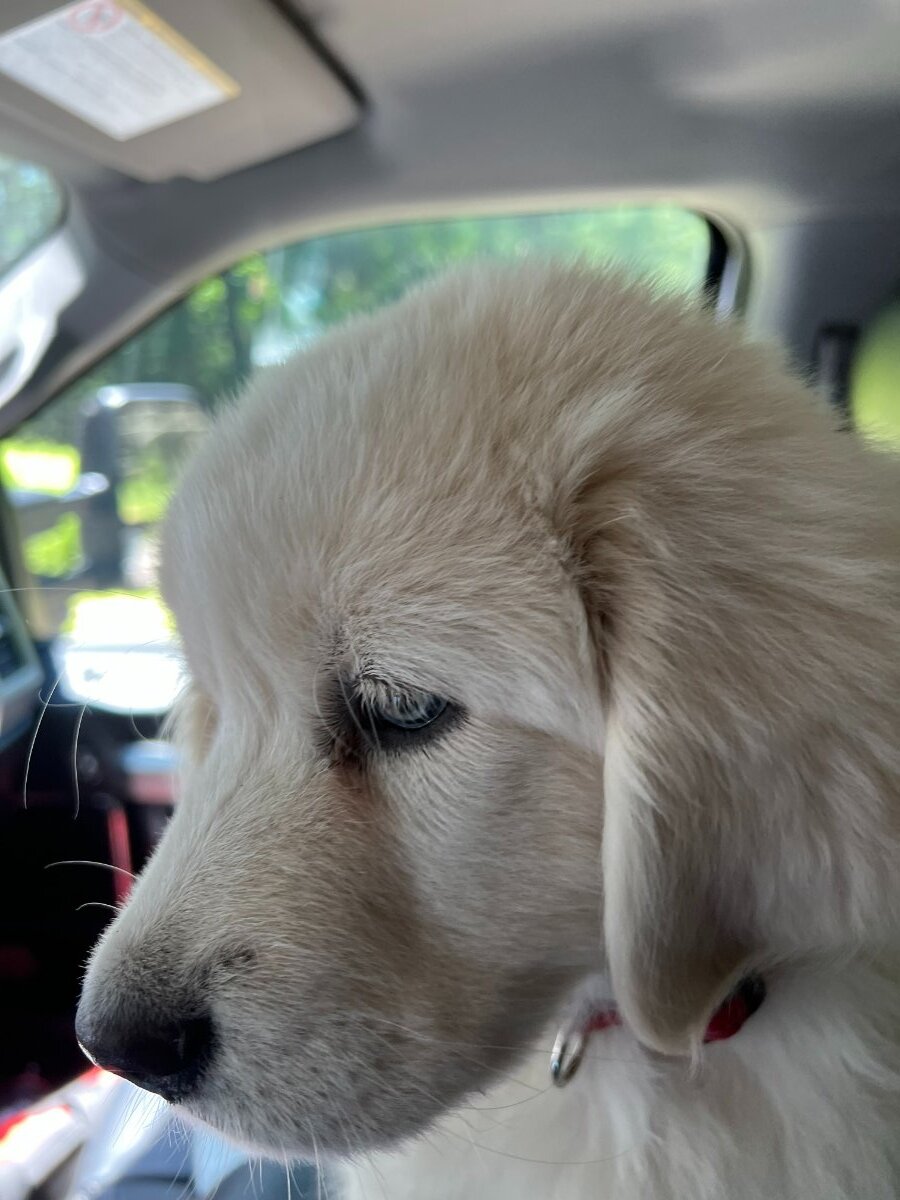
This is Maisie!
1 point
-
I was trying to find a post where I linked a few different bowls. Ah well, here's an Amazon search you can check out. Chewy has some, too, but fewer options than Amazon: https://smile.amazon.com/s?k=dog+slow+feed+bowl&ref=nb_sb_noss Without knowing how big she is / will be, here's one that's very similar to what I had for Momo. I liked how some of the food stuck in the "petal" so he had to work to get those last little bits. He would eat potato skins in 3 chomps as a reference for his speed. His bowl was a bit smaller (he at 1.5 cups each feeding): https://smile.amazon.com/dp/B082KB7PC8/ref=twister_B08BFY7MCP?_encoding=UTF8&psc=1 There's also the Kong Wobbler and since you're already separating the dogs it could be worth a look: https://www.chewy.com/kong-wobbler-dog-toy/dp/44195 Fair warning - it makes a lot of noise on hard floors. I've had to show each dog how to use it and they've all caught on quickly. If you have patience and time, this is another favorite around here: https://www.chewy.com/ethical-pet-dura-brite-treat/dp/180973 It takes a while to load the kibble, but keeps them busy. Sometimes I'll put a handful in there and the rest in the Wobbler just to change things up. This one is the same as the toy above - takes a little effort and time to get the kibble in there, but another well-liked treat toy: https://www.chewy.com/petstages-orka-tire-tough-dog-chew/dp/46935 And finally, our easiest toy. Easy to fill, easy for the dogs to empty, but still slows them down and so far has stood up to extra chewing: https://www.chewy.com/jolly-pets-monster-ball-dog-toy/dp/38809 I like this one as well, but Gertrude chewed the inside up. I made the mistake of thinking she had the hang of these toys and had grown out of that break it phase, but nope. She normally ignores the toys after the food is out so who knows what compelled her. However, I'll give it another try some day because it was a good one. https://www.chewy.com/planet-dog-orbee-tuff-mazee-puzzle/dp/38750 And then there's the good ol' placing piles of food around that she has to find. I don't know what type of space you're working with, but I'll put the idea in the hat just in case you can make it work. Oh, and if she won't destroy a snuffle mat that's another option. Mine will tear it up if I'm not monitoring.1 point
-
Hello and welcome to the forums, The diarrhea event can certainly play a role in the onset of barking more. If he was taken out more frequently, especially if he barked or moved around more making you suspicious he needed to potty, that could have left a strong impression in his mind and now with the diarrhea resolved, he may be expecting a response and be taken out as often as before. We do have forum members reporting similar regressions in crate training after diarrhea episodes, but usually they are short lived. It can certainly be challenging knowing at times when he really needs to be taken out due to diarrhea or just because he has gotten used to being taken out more frequently. If ever in doubt, it would be important to take him out on leash to the usual potty area for a few minutes to give him the opportunity to potty, being extra boring, no talk, no touch no interaction etc. and then, straight back in the crate.1 point
-
By the way, the website is working again. I managed to see the article.1 point
-
Grazie Adrienne Fido ti saluta! Thanks for all the tips on the harness.1 point
-
Perhaps you're right : he would try always to eat horse poop, or worms, or slugs during walks... So maybe kibbles open past one month isn't that big of a deal I was a bit afraid in the sense that he never had a problem with his kibble before But also heard that the kibbles refusal is a thing. As you said, eating the same thing over and over again each meal can be not very enticing at some point Dont want to waste food, but not at the expanse of my buddy's health1 point
-
Adrienne Thank you so very much for your comprehensive and helpful advice! You are amazing at what you do and we feel lucky to have found this great community! Thank you! jaimie1 point
-
Hi there! Welcome to the forums! Here's a big fact: From the day you bring your puppy home, your puppy will be constantly learning, and that includes both good behaviors and bad. If you keep your mind focused on this very important fact, you will be more likely to provide guidance so that your puppy will often make good choices. Puppies are learning with every interaction so they are perpetually in "training." Play is training. Resting is training. Walking is training and even learning to be away from you is training. Embracing all these life events as training opportunities is incredibly beneficial in helping a puppy develop into the dog of your dreams. Because let's face it: by encouraging good behaviors from the get-go, we can avoid the hassle of fixing bad habits that straighten over time and become more and more challenging to overcome. So how long should a puppy be trained? There are no general rules set in stone on how long and how often a puppy should be trained. It tends to vary on an individual basis. Just like us (think students who can sit in class concentrating on lessons while others are glancing out of the window daydreaming), some dogs can tolerate more training than others. For instance, how is the pup's attention span? Is she easily bored? You can generally train your pup as many times as you like as long as you pup is enjoying it and isn't getting bored. Nothing is worse for a puppy than a tedious training session that is boring or too difficult! In general, with a pup of 8 months, you can do about 10-15 minutes of training every day in brief sessions spread throughout the day. This would be a good place to start, making sure you end the session on a positive note and always when the pup is still interested. This builds a strong desire to learn. Your pup is now in the full adolescent stage so she'll benefit from training and some impulse control. You can read about the dog adolescent stage here: https://www.braintraining4dogs.com/members/archive/survive-dogs-adolescent-stage/ Making the sessions fun will make them less likely to feel "intense" for both owner and puppy. As the puppy matures and the attention span sharpens, it is possible to do longer sessions, but never to the point of boredom. So I would say start with brief sessions and watch how your puppy does. Now, dog owners may wonder whether it's best to focus on one behavior and teach it up to the level of mastery or whether it is best to teach a variety of behaviors at the same time. While there is really not right or wrong way to train behaviors (the important factor is that the puppy keeps learning and is eager to do so), with young pups it would be optimal to mix up several different behaviors. Puppies can get bored easily so mixing up different behaviors can help them stay focused. Puppy owners can also take advantage of their pup's energy levels and plan what to train accordingly. For instance, most puppies wake up with lots of energy or they may get the "zoomies" after finishing a meal. These are good times to take advantage of this energy bursts and train some recalls. Then, as the puppy gets a bit tired, why not focus more on some stationary exercises such as sit, down and stay? Once they are relaxed more, then you can resume with some more kinetic energy exercises such as polite leash walking. These exercises feature shifts in energy that are more in tune with the pups' activity levels and therefore can help maintain interest. On top of training different behaviors, it's important to also train them with different people and locations. All family members should be involved and take turns asking for behaviors. While training should start in a quite room, it should progress to involve various rooms of the house and the yard and then outside the home. I hope this answers your question, Happy Training! Adrienne .1 point
-
Hi there, Welcome to the forums. Sibling rivalry (also known as littermate syndrome) is a real thing and the main reason why many breeders and shelters have started no longer sending two puppies together in new homes. The puppies tend to bond a lot together and they may get into frequent squabbles as they mature and separating them may become problematic once they are deeply bonded. It seems like several dog owners encounter more problems when the puppies are of the same sex versus having one female and one male. However, it is also true that there are many sibling pups of the same sex living together happily, therefore there may be too many variables to make blank statements. I have personally raised two littermates (my Rottweilers) one female and one male and can say that it takes a lot of work because you'll need to separate them e.g. separate sleeping (initially starting with separate crates kept side-by-side, then gradually increasing distance), separate training, separate socializing, separate walking, so to help develop their individual personalities and prevent raising two "half-dogs' who depend too much on each other and risk failing to bloom and who may also learn to not pay attention to us. It is therefore best to start this early as it may become more difficult later on. These separation periods do not need to be an all-day ordeal for days or weeks. What counts is that the pups are separated for periods of time during the day, including nap times (one owner spends time with one puppy, while the other spends time with the other, and then possibly swapping) with the purpose of building a strong bond with each pup independently. While you are initially training them individually a lot, once they have a solid response to sit, down, come, etc, it is possible to work with them together every now and then to your advantage. For example, I like to have sibling pups sit before they are fed their meals or sit before I open a door to let them out to potty. I also like to dorecalls with them together when needed. This type of training teaches the pups to pay attention to us despite the distraction of being together and in my opinion is very valuable.1 point
-
Hi Jonathan, Interesting behavior! It almost seems like he has learned to wait for your wife's permission to go outside or he has become too dependent on the push. Something similar happens with dogs who are trained to sit by pushing on their backs rather than letting them perform the behavior on their own. This method of training has been abandoned for various reasons and a main one is because it is challenging and time consuming to get the dog to eventually sit then without the push. Here are some ideas that come to mind: -Just to play it safe, make sure there are no physical issues that may have caused some reluctance to go through the flap. Sometimes dogs may have achy joints or they may develop visual problems and these can interfere with their ability to hop outside the door. -Try to troubleshoot whether there may be a fear of the flap. It could be he is a little bit hesitant of going through the flap, but is then fine when past it, so he just needs that "push" or treat incentive to get past that part. So it may help to tape the flap up and see whether the flap may be part of the problem. If that's the case, let me know and we can troubleshoot this issue further. -Hide goodies around the yard. We can start placing super smelly treats scattered around the yard (initially right by the doggy door outside). Place these treats around when your dog doesn't see you, it has to be sort of a surprise. Then tape the flap so it stays open. Hopefully your dog will smell the treats and will hop out of the door on his own rather than waiting you to toss one. Once out, he should start eating the treats by the door and then he may find some other treats scattered elsewhere. This treasure hunt game should make being in the yard rewarding. Make it a habit for the first week to leave several goodies hidden (or even new toys) around the yard so that your dog looks forward to going out. Then, we can start gradually lowering the flap and start placing goodies every now and then instead of any times during the day. Making dogs find treats sometimes yes and sometimes no makes the act of searching for them quite addicting, sort of like playing slot machines in Vegas. The biggest issue though with this method is that we many end with a dog who will want to go out often just for the sake of searching goodies and not strictly to do business. Sometimes, as they head out to search for goodies, they forget about going potty only to pee or poop once inside. So this is an important potential drawback to consider. The good news is that treasure hunt games are fun for dogs and they help keep them mentally stimulated. However, we also need to think of the big picture. With fall and then winter close, we may be back to square one with you dog not wanting to go out. If we keep on hiding treasures around the yard every now and then, can that be enough to surpass the unpleasant feeling of the brisker air or cold sensation of snow on the feet? This depends on how aversive that may be perceived and how rewarding the treats are, and over all how these balance themselves. There are other things we can try to do to ameliorate the situation such as: Trying dog booties Letting your dog wear warm dog sweaters Shoveling a path to his potty area Make playing in the snow and rain fun: play games, toss treats, and feed your dog tasty treats Just thought to provide a few ideas, I hope this helps, Best, Adrienne1 point
-
Hi there, Welcome to the forums. To better assist you, I would need some more information. How old is this new puppy? What was the puppy doing exactly when the bite accidents have occurred? What was your German shepherd doing? Can you please describe more in detail both bite incidents? Did the first bite break the skin? If there was an injury can you describe it? Bleeding, needing stitches, What breed/age was the dog that passed 6 weeks ago? So sorry for your loss! Thanks! Adrienne1 point
-
OK! I have checked out your responses, and found that I'm already pretty much doing things the right way. I have told friends we are on "Henry Time," doing things slow, for the last two years. I do have Henry on meds now, and he is responding well to them. He did great over the 4th of July weekend, and we had a LOT of fireworks in the neighborhood. We will be working more with our ramp in the coming weeks. I appreciate the help!1 point
-
Initially Spotty would get angry and growl at Luna even when Luna drank from her own water bowl. That is how crazy it was at home. Anywho, now they sleep in the same bed. They are okay sharing the same water bowl. They walk together (although they don't understand when to wait when the other is eliminating). They sometimes even play which brings me immense joy. I am very glad to hear your two dogs are doing better and getting more along now. It sounds like they needed some adjustment period to get acquainted and once they got things sorted out, they were able to find a mutual agreement and now can co-habitate tolerating each other. I am sure it must feel very good to see them sleep and play. Here's where I am stuck. I live in a very busy city. Like even the smaller narrower lanes have vehicles coming both the ways and with them my ears and eyes are all super alert at every walk. Partly because both don't seem to understand or follow anything in all that chaos. I mean Spotty like you know doesn't obey any cues outdoors. And Luna who does listen to heel and attention heel outdoors is way too distracted upon seeing a person whose vibe either she likes (so goes running to them) or hates (starts lunging and aggressively barking), or vehicles she doesn't like (she will with all her force move past me hence always almost tripping me over and lunging at a fast moving vehicle). It's scary and really breaking my shoulder now. Both do the same lunging and running at cats and rats. And as usual it takes all my strength to either keep them put or pull them back if they've successfully taken me ahead with them. Either way walks have become more and more difficult. And nothing seems to fix this situation. Maybe I haven't tried the right things. I don't know. Also, Spotty who reacts upon seeing any dog is also troublesome now because Luna is learning from her. And both team up against each and every dog. See, few streeties around our area are themselves pretty agressive and we anyway take a sharp u-turn when that's the case. But there are times when the dogs are docile and just minding their business and Spotty will start barking and lunging at the dog. I really understand your situation. Many years ago, when my dogs were younger I was really trying hard to walk them together. I was really determined and believed that if I equipped myself with big willpower I would have achieved anything including walking them together. Well, I was wrong and was just setting myself for failure. Two large and not fully trained dogs and one petite woman is not a good match. Yes, it's true, training dogs is more about using your brain than relying on strength, but I was doing things backwards. Only once I started walking them one at a time was I able to see progress. Each dog received the individualized attention they needed and I was able to work on many levels I couldn't tackle before. Only after lots of practice one-by-one, was I able to see improvements on their walks. Also, using a front-attachment harness helped a lot. A front -attachment harness (e.g. the Sensation harness, the Easy Walk harness, the Walk your dog with love harness) made a world on difference along with training each dog individually and doing lots of reps of attention heeling in presence of distractions and Look at that exercises. I am trying this new thing where I instantly turn around when either of them resxt badly towards a dog. We walk a little away and then come back in the direction if the other dog. Walk till either of them react again. I say no and once again turn around. We keep doing thsi again and again till I feel there's some decrement in their growls. I don't know if I should continue this or not. The improvement isn't a lot. But it's not even been that many days. This sounds similar to the emergency u-turn: https://www.braintraining4dogs.com/members/archive/emergency-u-turn/ There are several benefits, the biggest being it that if you do it in a timely matter, you prevent rehearsal of the barking and lunging. The more a dog rehearses a problematic behavior, the more it puts root. It's a good management strategy for those times when a dog is coming your way and you aren't prepared for working on the issue. Luna wants to pee a lot. It was a lot more when she was on Predni (medicine for Lymphoma) and I think now that's become a habit. She sometimes takes me down as much as eight times. She's quite handful that way. So, that's one more thing I wanted to know is there way for me to maybe reduce her eight to ten walks. We don't have a lift and taking stairs so many times kills me. And there are literally the times when she takes me down for nothing at all. So, then I figured she is bored. So I started playing with her. But nothing. But since the training or at least since we've been training a lot more, her walks have decreased by one and sometimes two. Interesting how being on the prednisone may have made peeing a habit! If she is off this drug, it could very likely be that she just wants to spend time outside or just un-learned to hold it for long. However, always best to make sure she isn't suffering from a urinary tract infection so I would mention it to the vet. It could also be she is urine marking rather than really peeing. Does she produce a large amount? is she spayed? She also does this weird thing where she gets all agitated and barks at me when my leg moves while sleeping. They both sleep on my bed. And don't like sleeping anywhere else. Spotty besides me and Luna besides my legs. But she gets very angry when legs move naturally. So, now I subconsciously don't move my leg sometimes all night. Subconsciously not moving your leg at night to not upset your dog, must take quite some effort. That's very nice of you. It sounds like your dog has a strong startle response from being awakened by your leg movement. Generally, in an ideal situation, we expect a dog awakened by the owner accidentally brushing against his fur to care less about it or wake up, lift her head and look around and go back to sleep. Some dogs may lightly startle upon being woken up, but their startle responses don't involve aggression. The dog may perhaps yawn (not because he's tired but more because he got startled) and then go back to sleep. And then some dogs like yours may act grumpy when awakened from napping, and any touch may evoke an episode of growling or snarling. While these latter dogs may "use their words," there is always a risk for escalation and a potential bite. Now, something worth precising is that, just because some dogs react this way, doesn't necessarily mean that they are aggressive dogs. These dogs may be wonderful, sweet dogs when awake. It's just that they may react out of confusion sometimes. Many of these sweet dogs act almost confused and then apologetic once they realize they are in familiar surroundings with their loving owners. This form of startle response may be due to behavioral issues but may also stem from medical and neurological issues, and therefore, requires a close evaluation by a veterinarian and/or veterinary behaviorist. The safest option of course in the meanwhile would be sleeping in a separated area. Also considering that excessive wakening up startled may create a vicious cycle of the dog being tense, relaxing enough to sleep, being tense etc. which may impact the dog's quality of sleep and may trigger a worsening reaction over time. I hope this helps! Let me know if you need further assistance or want me to go more in depth on something and we can do more troubleshooting. Please keep me posted on how things go. Happy training! Best, Adrienne Disclaimer: behavior modification comes with risks. If your puppy or dog is showing any signs of aggression, please report to a dog behavior professional for an-in person assessments and guidance for safety and correct implementation of behavior modification techniques.1 point
-
Once they know target you can teach them all sorts of things, from practical to frivolous. I taught Gertrude how to open the baby gate for me when my hands are full, she also knows the difference between her bone, carrot, and duck toys. It's how I taught Momo to jump up. The idea there was to eventually get him to balance on his hind legs, but his arthritis settled in before we completed that training. Some people have taught their dogs to clean up their toys. Gertie rings a bell when she needs to go potty. Momo will give me a "kiss" (he punches me with his nose, lol). I Almost trained Mo to bring his bowl to me, but mostly he flips it up in the air or scoots it with his nose. They can be taught to push the handicap button if a door is equipped with one. It's largely up to the imagination because these guys can do so many things. Border Collie / Jack Russell?! How on earth did That happen?! :D I'd love to see a picture of those two breeds mixed.1 point